

“Excellent product (Alis); I redid my horizontal surfaces (steps and floor) after 2 1/2 years. They are in full sun in the morning… with a cleaning and sanding, my surfaces are like new!”
Finding the best stain for your deck is the mission of many customers who visit us. And we understand why. But the reality is that there is no miracle solution: the durability of an exterior stain depends on several factors. Surface preparation, the way you apply it… and above all, choosing the right product for your wood.
Because no, not all stains react the same way on all wood species. A product that performs exceptionally well on pressure-treated wood may completely fail on cedar or ipe.
We help you see clearly and choose the best exterior stains for your project to avoid unpleasant surprises… and above all, to avoid peeling.
Navigate directly to your deck type
What makes a stain “the best”?
Before looking for the best stain, one thing must be clarified: it is not just a matter of the product. Yes, quality matters… but it is only part of the equation.
What really makes the difference is the whole package: preparation, the way you apply the stain, the conditions at the time of application… and above all, the surface you are working on. A stain can provide exceptional results under the right conditions, then completely disappoint if used incorrectly.
In other words, the “best stain” always depends on the context. And if you want it to last, you must put it in a situation where it can perform to its full potential.
Now let’s look at the factors that actually influence a stain’s performance.
The type of wood you are staining
Wood is a very specific material. Each wood species has its own characteristics, and this directly affects the result of your stain. Density, porosity, presence of natural oils… all of this varies from one wood to another.
Concretely, this means that a product may penetrate exceptionally well into a softer wood, but have difficulty adhering to a denser or oilier wood. This is exactly why we don’t choose a stain at random: it must always be adapted to the type of wood you want to apply it to.
01
The best stains for a cedar deck
Cedar is a great classic for decks in Quebec—and it’s no coincidence that we’ve seen it everywhere for decades. We love it for its look: a beautiful warm color, a distinctive grain… it immediately adds character to an outdoor space.
But beyond aesthetics, its true strength is its durability. Cedar is naturally resistant to rot and insects, making it a reliable choice for a deck that will face the elements year after year.
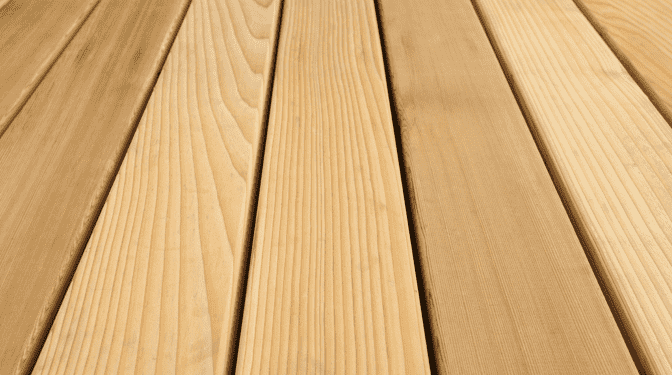
Cedar has another major advantage: its stability. Unlike other species, it moves very little over time. This ensures that cedar structures are less prone to twisting, warping, or deforming with the seasons.
One reason is its naturally lower moisture content (18% to 23% relative humidity in the boards) compared to pressure-treated wood (25% to 30%). It therefore cracks less when drying in the sun and will stay beautiful longer. Conversely, wetter wood will tend to move more as it dries, which can create warping or damage the structure.
Another important point: cedar contains natural oils. This is what makes it resistant to insects and certain molds—a big plus outdoors. However, these same oils can hinder the adhesion of certain stains, especially water-based ones. This is often where peeling problems begin.
That’s why the products that perform best on cedar are generally hybrid stains or penetrating oils. Their composition is more compatible with cedar resins, allowing for better penetration and much more durable adhesion.
Sansin Dec Hybrid Stain

“I have a 600 sq. ft. cedar deck built in 2021. At that time, I bought one of their products to stain it a color and protect it. After three years of bad weather, salt pool water, and two large dogs weighing 75 and 90 pounds playing on it the whole time, I am so satisfied with the quality and incredible endurance of their product that I just bought the same product again to refresh the wood protection. ”
M. Dalbec, client confirmé
It is a water-soluble hybrid stain. What does that mean? Even though the product base is water-based, its formula is enriched with natural oil resins, which completely changes how it interacts with the wood.
Concretely, it penetrates deep into the pores of the cedar and literally anchors itself there. We often speak of a “fusion” effect with the wood: the stain does not stay on the surface; it integrates directly into the fiber. This gives Sansin Dec a much more durable grip, in addition to reducing the risk of peeling.
Another very important point: this stain does not prevent the wood from breathing. The stain repels water, but still allows moisture to escape. This is exactly what you want on a cedar deck because it limits tension in the wood and long-term finishing problems.
Another significant advantage: it tolerates a higher moisture content than most stains. You can apply Sansin Dec on wood with a relative humidity of up to approximately 25%. This is interesting for your cedar deck, given that this wood tends to gray very quickly. Since Sansin can be applied to cedar much sooner than other stains (only 3 months after construction), you significantly reduce your deck’s exposure to graying.
It is for all these reasons that this stain has earned its place as a “favorite” at Colobar for over a decade. It performs really well where many other products fail.
And as for the look, you are not limited: it is available in a very wide variety of colors (over a hundred), from an ultra-natural finish to more opaque shades. Because in the end, the best stain is also the one that gives you exactly the color and finish you want.
Alis Penetrating Oil

“Best product for a cedar balcony. It does not peel; you must prepare well and then apply. It needs to be refreshed every year or every 2 years because it wears off faster at the wood knots. Expensive (nearly 3X the price of another ordinary product) but worth it because there is no peeling, so it's easier to maintain and refresh. . It lasts much longer on vertical surfaces.”
M. Dalbec, client confirmé
Alis is a blend of natural oils that work together to offer truly complete protection. Each oil has its role, and in the end, it results in a product that protects your wood against UV rays as well as water, insects, and mold.
Where it performs particularly well is on cedar that has had time to dry properly—ideally around 6 months. Under these conditions, the oil penetrates deeply and provides a resistant and durable finish.
Another much-appreciated aspect of Alis is its slightly satin, rich finish that enhances the wood without losing the natural look. And above all, it makes the surface hydrophobic: water beads on the surface instead of penetrating the wood. This is exactly what you want to keep your deck looking beautiful longer.
Alis also makes maintenance easier for you. If you maintain it regularly, you can simply refresh without sanding between coats. And since the oil saturates the wood pores from the start, you use less and less of it over time for maintenance.
Regarding colors, Alis is available in about twenty semi-transparent colors, which you can mix together if you want to achieve a unique look.
To learn more
Do you want to learn how to apply Dec and Alis, step by step? Consult the following videos:
02
The best stains for a pressure-treated deck
Pressure-treated deck
Pressure-treated wood is another great classic for decks—mainly because it is more affordable than cedar. In Quebec, we generally use pine, spruce, or fir that is soaked in preservatives to make the wood more resistant.
This treatment gives the wood a good boost: it protects it against moisture, fungi, and, to a certain extent, against all types of external aggressions. Its lifespan is therefore significantly improved.
But beware—treated does not mean you shouldn’t apply a finish over it. If you leave it bare, the wood will still suffer the effects of sun and moisture. It will fade, gray, blacken, and in the long run, it will eventually rot if you do not protect it.
That’s why applying a finish remains essential. A good stain or oil will protect the surface, slow down aging, and keep your deck looking beautiful much longer
Best products for a pressure-treated deck
Pressure-treated wood is quite versatile: it accepts most stains and oils without much trouble. However, that doesn’t mean all products will perform the same way.
Over time—and especially with many field tests—we have realized that there are certain options that clearly stand out when it comes to achieving a durable and easy-to-maintain result.
At Colobar, there are two products we regularly recommend for pressure-treated wood because they offer an excellent balance between durability, ease of application, and aesthetic result.
Pressure Plus Stain

“Easy-to-access website
Mike Faria, client confirmé
Easy purchase and very fast product shipping
I recommend Pressure Plus to everyone; it applies and protects very well”
Pressure Plus is a stain specifically designed for pressure-treated wood. Its formula is inspired by products like DEC, but with a slightly more liquid consistency, which facilitates penetration into pressure-treated wood, which is often wetter.
Its role is simple: stabilize the wood and improve its overall resistance to the elements. On a pressure-treated deck, this considerably delays the aging of the wood.
It is also an interesting option budget-wise. If you want the simplest option, a single coat can do the job with an annual refresh. If you want to further extend durability, you can apply two coats from the start.
As for the look, we stay with classic and easy-to-integrate shades: brown, gray, and clear (honey).


“Good service, good advice, fast reception. Follow instructions carefully. Perfect color.
Marie Claude Coupal, cliente confirmée
As another comment says, watch out for overlaps. Also, your wood must not be hot (avoid doing this work in direct sunlight) otherwise the stain spreads less well and the risk of overlapping can occur. ”
DEC is also an excellent choice for pressure-treated wood. Its complete formula effectively protects against deterioration while being perfectly compatible with this type of surface.
One of its big advantages is its tolerance to moisture. Unlike many products that require very dry wood, DEC can be applied to boards that are still relatively damp. And that is particularly useful with pressure-treated wood, which often contains a lot of moisture, especially in the first few months.
You can therefore stain your deck faster without compromising product performance… and avoid waiting a full season before protecting your deck.
03
Exotic wood decks
Ipe deck
Ipe is a wood in a class of its own. We are talking here about an extremely dense wood, recognized for its impressive durability—some ipe decks can last up to 50 years without a problem. It is also a wood highly appreciated for its elegant appearance.

But even if ipe is ultra-resistant, it is not immune to the sun. Without protection, it will gray like any other exterior wood.
Where it gets complicated is with the finish. Its density is so high that most stains simply cannot penetrate. They stay on the surface of the boards and peel very quickly. This is often where ipe deck owners get discouraged.
On ipe, there aren’t a thousand options: you must go with a very penetrating natural oil. It is the only type of product capable of penetrating even slightly into the wood fiber.
However, you must adjust your expectations regarding maintenance. Even oil has difficulty penetrating ipe fibers, which means it wears out faster than on other more porous types of wood. You will probably need to refresh the finish every year to maintain a beautiful look.
Teak deck
Teak is an exceptional wood often associated with marine environments and uses—and for good reason. This tree originates from tropical climates in Asia, which gives it a natural resistance to moisture. That’s why it’s found on boat decks. Stable, durable, elegant… it’s a high-end choice, for both furniture and decks.
However, even if it resists water very well, it does not escape the effects of the sun. Like other woods, it will gray if not protected.

Stain specifically designed for teak decks:
ALIS 567 Teak Oil by Livos

“Easy to use, this product gave me excellent results.”
Guy Perreault, client confirmé
Livos Alis 567 Oil is a version specifically adapted for teak. It is designed to preserve the natural color and richness of the wood without tinting it.
If you want to keep the original look of teak, this is the product you need. However, as it has little to no pigment, its UV protection is more limited. So if your deck is very exposed to the sun, the original version of Alis (slightly tinted) will offer better long-term protection.
Thermally modified wood deck
Thermally modified wood is an improved wood without chemicals. The boards are heated to very high temperatures (between 160 and 245°C), which removes moisture and transforms the wood structure. This makes it more stable, more resistant to fungi, insects, and mold… and as a bonus, it takes on a beautiful richer shade that resembles exotic woods.

But beware: this transformation also comes with a small constraint. Thermal modification tightens the wood pores, making it much less absorbent. Therefore, if you apply a classic stain, it will stay on the surface and risk peeling in record time.
That’s why with thermally modified wood, you must use very penetrating natural oils. These are practically the only finishes capable of anchoring well into the wood. And since the material absorbs less, you will also consume less product during application.
Best stains for exotic woods (ipe, teak, and thermally modified wood)
When talking about exotic woods like ipe, teak, or even thermally modified wood, you have to forget about many “standard” products. These woods are dense, rich in oils… in short, they don’t let just anything in. If you choose your finish poorly, it will stay on the surface and deteriorate quickly.
That’s why we almost always turn to very penetrating natural oils
Alis by Livos
“EXCELLENT product... easy to use, gives a very beautiful result”
Martine, cliente confirmée
Alis is a safe bet when working with exotic or thermally modified woods. It is a natural oil designed to penetrate deep into very dense fibers—exactly what is needed for this type of wood where most products stay on the surface.
As it soaks directly into the pores, it offers durable protection without creating a film. This limits the risk of peeling in addition to simplifying maintenance. No need to sand everything every time—a cleaning, a new coat, and your deck is good for another season. When you know that ipe or teak requires an annual refresh, ease of maintenance is not to be overlooked.
Manufacturer’s Note: The 048 Chestnut shade is often used to approximate the natural color of several exotic woods. However, the result can vary from one project to another. The rougher the surface, the darker the color will appear—so it’s always worth doing a test before starting on a large scale.
Extéria by Ligna

“Excellent service and fast delivery when ordering online.
Barbara, cliente confirmée
Thank you very much.”
Extéria by Ligna is the kind of product that performs very well on temperamental woods like ipe, teak, or torrefied wood. It is a very penetrating oil—exactly what is needed to adhere to dense woods where more “standard” products fail.
Its value for money is exceptional, so you can protect your exotic wood without spending large sums. Its only drawback? It is a wipe-off oil. You must therefore apply it to the surface with a brush, then, after a few minutes, wipe off the excess. This adds an extra step during application, but it also ensures much greater coverage.
In the end, keep one simple thing in mind: there is no single universal “best stain.” The right choice is the one that is compatible with your wood and gives the look you want. Because a finish can be ultra-high-performing, but if you don’t like the look, you might regret it every time you look at your deck.
Start your project now!
You will find all the products you need directly on our website.
- Start by measuring the dimensions of your patio to calculate the quantities you need.
- Choose the product that suits your deck’s wood species.
- Place your order online and choose between in-store pickup and home delivery.
Want to learn more about exterior stain? Consult the section of our blog dedicated to this subject!
Products found in this article.

Livos Alis Exterior Wood Protection Oil
Sansin DEC – Wood Deck Stain

Ligna Extéria Exterior Deck Oil
Pressure Plus Pressure-Treated Wood Protector
Q&A
Q. Why does the same stain give a great result on one wood and fail completely on another?
Because each wood species reacts differently. A wood like cedar is more porous and contains natural oils, whereas ipe or teak are extremely dense. A stain may penetrate well into one wood and stay completely on the surface of another. When a penetrating stain stays on the surface, it almost always ends up deteriorating quickly. The choice of product must therefore always be dictated by the wood’s ability to allow the stain to adhere and penetrate.
Q. How do I know if my wood is too dense for a "standard" stain?
A good indicator is the speed at which the wood absorbs water. If you pour a few drops and they stay on the surface without penetrating, you are likely dealing with a dense wood (ipe, teak, thermally modified wood). In that case, forget classic stains: you must go with a penetrating oil. Otherwise, even a good product will react poorly.
Q. Can I use the same product on different sections of my deck?
Yes, but with caution. If your deck mixes several species (for example, pressure-treated wood for the structure and cedar for certain sections), a single product may work… but the look and durability will not be identical everywhere. In some cases, it is better to adapt the product to each type of wood to avoid differences in color or wear over time.
Q. Why do some finishes require annual maintenance while others last longer?
It mainly depends on the type of wood, not just the product. Very dense woods like ipe or teak absorb little, so the finish stays more on the surface and wears out faster. Conversely, a more porous wood like cedar allows the product to penetrate further, which extends its durability. This is not necessarily a defect of the product, but a reality that changes from one wood to another.
Q. Is an oil always a better choice than a stain?
Not necessarily. Oil is essential for very dense woods, but on woods like cedar or pressure-treated wood, a hybrid stain can offer an excellent balance between penetration and protection. The true criterion is not “oil vs. stain,” but the compatibility between the product and your wood.
Q. Why does the final color vary so much from one wood to another with the same product?
Because each species absorbs and reflects color differently. The density of the wood will influence the color. Even the surface texture (rougher or smoother) can influence the result. That’s why a test on a small area is always a good idea before staining the entire deck.


Another point to consider: since teak is becoming increasingly rare, it is used less than before for decks. So if you have one, it’s all the more worth maintaining it well.
Like ipe, teak is a very dense wood. This causes the same adhesion problem: most stains do not penetrate correctly. You must therefore turn to a very penetrating natural oil to ensure effective protection.
And regarding maintenance, it’s the same reality as ipe. If you want to preserve its original color, an annual refresh will be necessary in most cases.