

Delivery: Ready to ship anywhere in Canada
“High-quality paint that I have been using for years with Colobar’s impeccable service.”
Do you dream of transforming the appearance of your brick home without undertaking major renovations? Painting it with exterior brick paint can completely change the style of a facade and give an older house a spectacular new look. Very popular in Quebec, brick houses often have an impeccable structure… but a color or look that dates from another era. With the right products and proper preparation, repainting exterior brick can modernize the home’s appearance, unify an aging facade, and give it a whole new personality — we explain how to do it and what the best products are for your project!
Navigate through the article
Click on the subtitle that interests you to read the relevant section directly:
Effectivement, les maisons de briques sont très répandues au Québec, et ce depuis le 19e siècle!
Les maisons de briques font partie du patrimoine québécois, et de peindre ta façade en brique est une excellente manière de t’approprier ce patrimoine, en lui donnant une touche plus personnelle, au goût du jour.
Avant tout, réglons un malentendu concernant le fait de peindre de la brique
Il existe une croyance populaire selon laquelle peinturer la brique emprisonne l’humidité a l’intérieur de celle-ci et cause, à la longue, la moisissure de la brique. Cette idée vient cependant d’une époque où l’on peinturait à l’extérieur avec des peintures à base d’huile, qui scellaient complètement la brique et l’empêchait effectivement de respirer.
Aujourd’hui, les peintures à base de latex et d’acrylique agissent comme hydrofuge (c’est-à-dire qu’elles protègent la brique de l’infiltration d’eau) mais possèdent à la fois une finition microporeuse qui permet à l’humidité de s’échapper de la brique. Pour cette raison, avec la peinture extérieure actuelle, il est possible de peinturer un mur en brique sans craindre que la brique se pourrisse ou se détériore.
01
Prepare your exterior brick before painting it
Before applying exterior brick paint, you must take the time to properly prepare the surface. This is an essential step if you want your exterior brick paint to adhere correctly and maintain a beautiful finish for several years.
If your brick facade has already been painted and the old paint is flaking, you must first remove anything that is no longer firmly attached. Otherwise, the new coat of paint risks peeling prematurely as well.
Since brick is a porous and textured material, it easily retains dust, contaminants, and sometimes even traces of mold. Thorough cleaning is therefore essential before painting exterior brick.
How to clean brick
To ensure good adhesion of your brick paint, we recommend using a residue-free preparation cleaner, such as Krud Kutter. This type of product helps to dislodge dirt and grease without leaving residues that could impair paint adhesion.
- Dilute Krud Kutter at a ratio of 6 parts water to 1 part product.
- Apply the solution with a brush, roller, or sprayer, if you want to work faster.
- Scrub the brick with a nylon brush to thoroughly dislodge dirt. Make sure to clean the joints well too. If you apply the cleaner with a pressure washer, you can skip the scrubbing step with the brush.
- Let Krud Kutter act for 3 to 5 minutes
- Rinse with clear water, then let dry completely (24 to 48 hours) before applying the brick paint.
A clean and well-prepared surface makes all the difference when you want to paint exterior brick durably — especially with the temperature variations experienced in Quebec.
02
Do you need to apply a primer coat?
In most cases, no. A quality exterior brick paint can generally be applied directly to a clean and well-prepared surface.
However, there are certain situations where applying a primer is highly recommended.
For example, if you want to cover a dark color — like traditional brick red — with a lighter color, a primer will greatly facilitate the work. It allows for better coverage of the old color and a uniform result with fewer finish coats. In other words: less paint, less time… and often a better result.
Primer can also be useful on an old, very porous brick facade. Over time, some bricks become more absorbent and can retain more moisture. This excess porosity can eventually contribute to water infiltration problems or impair the adhesion of exterior paint on the brick.
In this case, an acrylic primer of the Block Filler type can be an excellent option. This type of product helps to fill the pores of the brick and uniformize the surface before applying exterior brick paint.
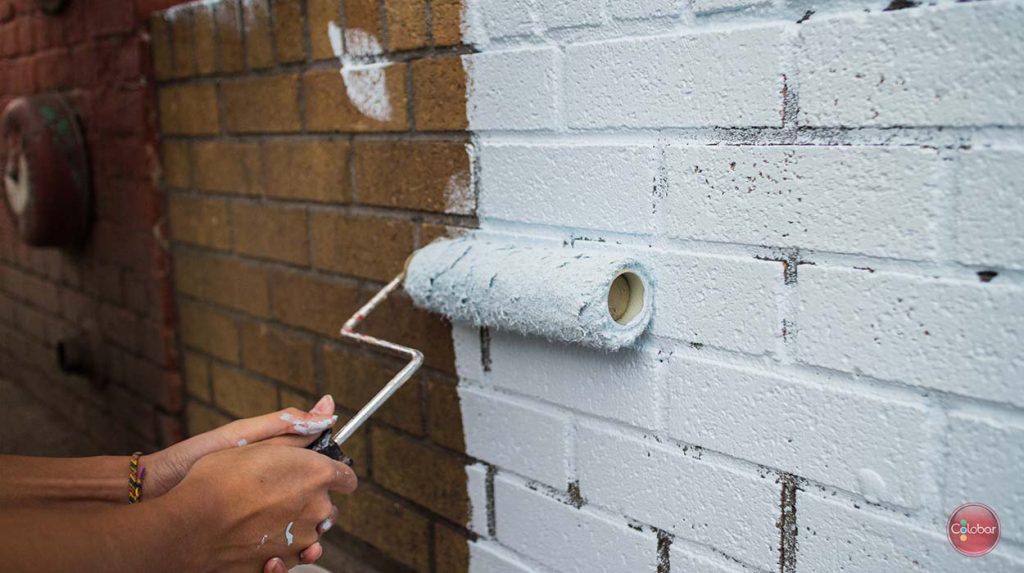
03
Painting the brick
Quelle peinture choisir pour peindre la brique
Pour obtenir un résultat durable lorsqu’on peint une façade de brique, il est important de choisir une peinture extérieure acrylique de haute qualité, comme Aura ou Régal extérieur. Ce type de peinture pour brique résiste beaucoup mieux aux intempéries, aux rayons UV et aux importantes variations de température qu’on connaît au Québec.
Côté fini, le mat reste généralement le choix le plus populaire pour une peinturer une façade en brique. Pourquoi ? Parce qu’il respecte davantage l’aspect naturel et minéral de la brique. Comme il reflète très peu la lumière, il donne un look plus doux. Si tu veux un léger reflet, tu peux aussi opter pour un fini peu lustré, similaire à un velouté.
Choisir le bon rouleau
Quand on applique une peinture pour brique, le choix du rouleau fait une énorme différence.
Si ta brique est très rugueuse ou comporte beaucoup d’aspérités, utilise un rouleau à poils épais de 15 mm ou 20 mm. Ça te permet de bien appliquer la peinture dans les creux et les reliefs du mur. Avec un rouleau trop mince, tu auras de la misère à atteindre certaines sections.
À l’inverse, si ta brique est plus lisse, un rouleau de 10 mm ou 13 mm fera très bien le travail.
Pour les joints plus étroits ou les petits détails difficiles à atteindre, garde sous la main un pinceau mince d’environ 1 pouce.— ou même un pinceau d’artiste dans certains cas.
Appliquer la peinture pour brique étape par étape
- Applique la première couche en t’assurant de couvrir les joints.
- Laisse sécher un minimum de 4 h. Si tu veux être certain.e d’avoir les meilleurs conditions de pose pour la 2e couche, ça vaut la peine d’attendre au lendemain.
- Applique la 2e couche en procédant de la même façon que pour la 1re.
Pendant les 24 h après avoir peint ta brique, fais attention de ne pas accrocher la peinture.
Les températures idéales pour peindre ta brique extérieure
Quand tu peintures une brique extérieure, les conditions météo sont presque aussi importantes que la peinture elle-même.
- Évite de peindre en plein soleil ou sur une surface chaude.
La peinture risque de sécher trop rapidement, ce qui peut nuire à l’adhérence et laisser un fini inégal.
- La brique doit être complètement sèche avant l’application.
Comme il s’agit d’un matériau poreux, elle peut conserver de l’humidité plus longtemps qu’on le pense, surtout après la pluie.
L’idéal est donc de prévoir au moins deux journées sans pluie afin de pouvoir appliquer tes deux couches dans de bonnes conditions.

04
Decorating tips for choosing your brick paint color
A little decor thought
We asked Martine Bourdon, a designer at Colobar, for her decorating tips for an exterior brick wall painting project:
“When choosing a color to paint your exterior brick, you must always consider the entire facade. Your brick paint must harmonize well with the elements that will remain as they are: the roof, doors, windows, aluminum, soffits, or even the foundation. It is often this balance that makes the difference between a successful result and one that looks “out of place.”
Another important point: colors almost always appear lighter outdoors than in the store. Natural light completely changes the perception of shades. Before choosing your brick paint color, take the time to bring some samples home and look at them directly on the facade, at different times of the day.”
Finally, also consider the style of your neighborhood. That doesn’t mean copying the surrounding houses, far from it. But when a brick facade integrates well into its environment, the result often looks more chic and timeless.”
Painting your brick is an easy way, which you can undertake yourself, to transform the look of your home!
Start your project now!
You will find all the products you need directly on our website.
- Start by measuring the dimensions of your brick facade to calculate the quantities you need.
- One gallon of exterior brick paint covers approximately 300 to 400 sq ft
- Choose the color you like.
- Place your order online and choose between in-store pickup and home delivery.
Want to learn more about different exterior paints? Click here!
Products found in this article.

AURA Exterior Paint

Regal Exterior Paint

Lint-free roller cover 15 mm
Q&A
Q. Can exterior brick paint trap moisture in the wall?
Only if you use a product not designed for masonry, such as old oil-based exterior paints. Brick must be able to breathe naturally to allow moisture to escape. This is why breathable acrylic exterior paints are preferred for this type of project.
Q. How do I know if my brick is too damaged to be painted?
If the mortar joints are crumbling easily, some bricks are spalling, or you observe persistent white traces (significant efflorescence), it is best to correct these problems before painting the exterior brick. Paint will not solve a structural or infiltration problem.
Q. Can a brick facade that has already been treated with a water repellent sealant be painted?
Sometimes yes, but it’s a more complex case. Some water-repellent treatments completely prevent the adhesion of brick paint. If water beads strongly on the surface even after cleaning, it is possible that an old treatment is still active. In this case, an adhesion test often needs to be performed before painting the entire brick facade.
Why are some painted bricks stained or uneven after a few months?
Often, the problem comes from moisture circulating through the wall. Water infiltration, worn joints, or poor indoor ventilation can cause minerals to surface or create variations in the finish. This is not always a paint problem, but rather a symptom of moisture in the masonry.
Q. Is it risky to apply a dark color to an exterior brick wall?
It mainly depends on sun exposure. Very dark colors absorb more heat, which can increase expansion movements on certain surfaces. On an old facade or already weakened brick, this can accelerate certain signs of wear. Before choosing a very intense black or brown, it is worth evaluating the general condition of the masonry and the sun exposure of the facade.
Q. Once the brick is painted, can you return to natural brick?
In practice, it is difficult. Brick is porous, so the paint penetrates the material rather than simply remaining on the surface. Even with a stripper or abrasive blasting, it is rare to restore the original appearance of the brick. Therefore, before painting exterior brick, it should be seen as a long-term transformation rather than a temporary change.


