Have you ever had the bad experience of your epoxy floor or countertop yellowing over time or from sun exposure? Epoxy is now used on all sorts of surfaces and integrates with a wide variety of decorative styles. Its great durability makes it a particularly appreciated finish, but if it yellows, epoxy largely loses its appeal. If you want to preserve the original color and appearance of your epoxy, it is important to choose an epoxy designed to resist UV rays.
We’ll show you which epoxy to use based on your project and how to apply it!
01
What causes epoxy yellowing?
To prevent your epoxy from yellowing, you must first understand what causes the phenomenon.
The main culprit is UV rays. Over time, their exposure degrades the polymers that make up the epoxy, which can gradually give the coating a yellowish tint.
The phenomenon is especially visible outdoors, where epoxy is directly exposed to the sun. But even indoors, epoxy can yellow if installed near a very sunny window. Artificial lighting can also contribute to yellowing, but the phenomenon is generally much slower and less pronounced.
02
How to prevent epoxy from yellowing?
Not all epoxies react the same way to UV rays. Some formulas contain UV stabilizers or protectors that can significantly slow down yellowing.
If the surface you want to cover is directly exposed to the sun, or if you simply want to preserve the original color of your epoxy for as long as possible, opt for a product that offers UV protection.

Some epoxy choices that do not yellow
-
Crystalopoxy

“Very good product and it works wonderfully. Ultimately, a very beautiful result. ”
R. Gendreau, client.e confirmé.e
Crystalopoxy is a versatile epoxy suitable for a wide variety of projects, from small creations to large surfaces. You can use it for a concrete floor as well as a bedside table or a wooden countertop. It can be poured, applied with a squeegee, or with a roller, depending on the type of project.
Thanks to its UV resistance, Crystalopoxy retains its crystalline appearance longer and limits yellowing. Be careful, however: even if it resists UV rays, it is not designed for outdoor use. It is therefore particularly interesting for indoor projects exposed to natural light, for example, a floor or a table located near a window.
Crystalopoxy also offers excellent resistance to abrasion and chemical contaminants, making it a durable finish for a host of projects.
-
Nu-Lustre 57

“Excellent service from Colobar. Fast delivery. Effective product. ”
Stéphane, client confirmé
Nu-Lustre 57 is a casting epoxy designed for small to medium-sized outdoor (and indoor) projects. Its formula is specially designed to block UV rays and slow down epoxy yellowing as much as possible.
Thanks to its thickness and application method, it is particularly suitable for craft and decoration projects. You can use it to cover a wooden stump to preserve it and give it a glossy finish, protect a photo while keeping the image clearly visible, or encapsulate small objects like seashells.
It can also be used to cover wooden, ceramic, or concrete countertops. To apply it, simply pour Nu-Lustre 57 directly onto the surface, then help it spread evenly with a spatula.
-
Passport-Elite Polyaspartic

Price per sq ft: $1.50 to $1.60
- 98% solids formula, two-component, very low VOC
- Fast return to service (48 h), ideal for commercial or industrial environments
- Resistant to chemicals, UV, and abrasion
- Indoor or outdoor use, does not yellow in sunlight
- Adheres to concrete, fiberglass, steel, wood
- Compatible with vinyl flakes for non-slip finish
The 98% solids polyaspartic is designed for larger projects.
This industrial-grade product is available in 2-gallon kits and mixes at a 1:1 ratio. Once the two components are mixed, you have a limited time to work. Its fast curing time, approximately 20 minutes, therefore requires good preparation and a certain efficiency during application.
The 98% solids polyaspartic offers excellent resistance to UV rays and chemicals. It can be used both indoors and outdoors, making it a particularly interesting option for surfaces exposed to the most intense conditions.
For example, it can be used to create a durable coating on an outdoor patio. However, it is not the product I recommend for your first coating project. Its very short working time leaves little room for maneuver and can make application more demanding.
If you already have experience with applying epoxy coatings or other two-component products, polyaspartic is an excellent solution for a very durable finish that will not yellow!
-
Two-component water-based polyurethane
“We were very satisfied with the products and service. Easy to apply and clear instructions. We will recommend without hesitation. Thank you 🙂 ”
Josee Plante, cliente confirmée
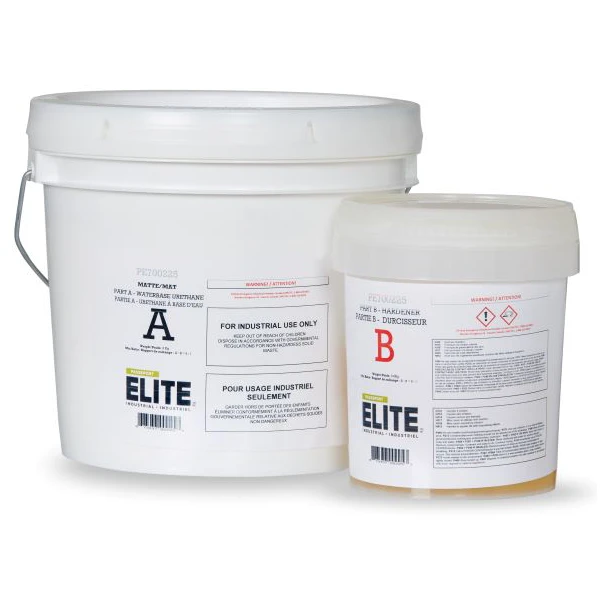
Polyurethane is also a two-component coating, this time with a mixing ratio of 5 (resin) : 1 (activator). A particularity of this product is that it is water-based. This allows for a fairly quick drying time between coats.
Its pot life is also longer (1 to 3 hours), which gives you more time to apply it. If this is your first time applying a two-component coating, it can be a good product to familiarize yourself with.
Water-based polyurethane is designed primarily for interior concrete floors, and it resists UV rays as well as chemicals and abrasion.
It also stands out by being available in several finishes: matte (13% light reflection), satin (35%), and glossy (90%). This makes it an excellent product choice if you want a matte finish epoxy floor.
Polyurethane can be applied outdoors, but only as a topcoat: if you apply it directly to concrete, the moisture in the slab will prevent it from hardening. The ideal is to apply it over a polyaspartic layer.
Want to know which epoxy to choose for your project? Consult this table, it will answer your questions!
| Project Type | 98% Solids Polyaspartic | Nu-Lustre 57 | Crystalopoxy | 2-Component Water-Based Industrial Polyurethane (5:1) |
|---|---|---|---|---|
| Large-scale outdoor project | ✓ | |||
| Heavily used outdoor patio | ✓ | |||
| Outdoor surface exposed to UV | ✓ | ✓ | ✓* | |
| Large interior surface project | ✓ | ✓ | ✓ | |
| Interior concrete floor | ✓ | ✓ | ✓ | |
| Wooden, concrete, or ceramic countertop | ✓ | ✓ | ||
| Wooden table or furniture | ✓ | ✓ | ||
| Craft and decoration project | ✓ | ✓ | ||
| Thick pour for encapsulating objects | ✓ | |||
| Cover a wooden stump | ✓ | |||
| Protect a photo or small objects | ✓ | |||
| Interior surface exposed to natural light | ✓ | ✓ | ✓ | ✓ |
| Project requiring excellent abrasion resistance | ✓ | ✓ | ✓ | |
| Project requiring excellent chemical resistance | ✓ | ✓ | ✓ | |
| First project with a two-component coating | ✓ | ✓ | ✓ | |
| Project requiring fast application | ✓ | ✓ | ||
| Floor with a matte finish | ✓ | |||
| Project requiring a long working time after mixing | ✓ | |||
| Application as a topcoat on an outdoor coating | ✓ |
* Water-based industrial polyurethane can be used outdoors only as a topcoat, over a polyaspartic coating. It should not be applied directly to outdoor concrete.

03
How to prevent your epoxy from yellowing... while saving money!
Have you already finished your epoxy project and want to preserve its color and shine for as long as possible? A good solution is to add a UV-resistant topcoat over the epoxy.
Be careful with the application time, however. If your epoxy has been dry for more than 48 hours, you will first need to prepare the surface by lightly sanding it with an orbital sander and 80-grit sandpaper. This step creates an adhesion profile to promote the adhesion of the new coat.
If you apply the finish within 48 hours of the epoxy, you can generally proceed without having to sand the surface, following the manufacturer’s recommendations.
For a project like a garage or an outdoor patio, you can also combine two products: apply a first coat of epoxy, then cover it with a UV-resistant polyaspartic coat.
This combination allows you to benefit from the advantages of both products. Epoxy is generally less expensive than polyaspartic, while polyaspartic offers excellent resistance to UV rays. You can therefore obtain a durable and yellowing-resistant finish while controlling the overall cost of the project.
Do your project step by step
-
Clean the floor
It’s important that you first make sure to remove all traces of dirt and contaminants from the surface. The best thing you can do for this is to use a degreasing cleaner like Krud Kutter or a surface preparation cleaner.
Once cleaning is complete, allow to dry completely before moving on to the next step.
-
Sand the old epoxy coat (if it’s been more than 48 hours)
If it’s been more than 2 days since you applied the last epoxy coat, you’ll need to sand.
- Use an orbital sander with 80-grit sandpaper.
- Sand only to scuff the surface (de-gloss). You don’t want to remove the entire coat.
- Go over the entire surface with the sander to get a smooth, even finish.
When finished, dust off with a vacuum cleaner or a cloth.
-
Apply the epoxy that best suits your project
Consult the table above to ensure you choose the right product. In summary:
- For a floor or patio: choose polyaspartic or polyurethane.
- For indoor furniture or tables: Crystalopoxy is probably the most cost-effective option, but Nu-Lustre 57 will also perform well.
- For covering collectibles or wooden stumps: Nu-Lustre 57 is the product you need!
Start your project now!
You will find all the products you need directly on our website.
- Start by measuring the dimensions of your surface to know the quantities you need.
- The medium Crystalopoxy kit covers between 80 (32 mils) and 300 sq ft (8 mils).
- Nu-Lustre 57 covers 40 sq ft per gallon (very thick coat for furniture and countertops).
- Polyaspartic covers 400 sq ft per kit (8 mils)
- A polyurethane kit covers between 400 (6 mils) to 600 sq ft (4 mils).
- Choose the product that best suits your project and the result you want to achieve.
- Place your order online and choose between in-store pickup and home delivery.
Want to know more about epoxy and how to apply it? Consult the section of our blog dedicated to this topic!
Products found in this article.

UV-Resistant Wood Epoxy Nu-Lustre 57 by Circa
98% Solids Industrial Polyaspartic
CRYSTALOPOXY – Multi-Surface Finish Epoxy
FAQ
Q. Can a UV-resistant epoxy be used outdoors without other protection?
Not necessarily. UV resistance does not automatically mean that the product is designed to withstand weather, water, and temperature variations. You must always verify that the chosen product is actually suitable for outdoor use. For example, Crystalopoxy is UV-resistant, but it is not designed for outdoor use.
Q. Do I have to replace epoxy that has already yellowed?
Not necessarily. If the epoxy is still in good condition and adheres well to its substrate, it is sometimes possible to cover it with a UV-resistant finish. This solution allows you to keep the existing system rather than starting over. However, if the old coating is detached, cracked, or otherwise deteriorated, these problems must be resolved before adding a new coat.
Q. Can an anti-UV epoxy completely prevent yellowing?
No product should be considered completely immune to aging. UV protection primarily helps to significantly slow down the effects of UV rays. The level of resistance depends on the product’s formulation and its exposure. A surface constantly exposed to the sun will generally age more quickly than an indoor surface protected from direct light.
Q. Is yellowing more visible with certain epoxy colors or effects?
Yes. The color change can be much more apparent on certain shades or textures than on others. A colorless, white, or very pale epoxy, for example, will show a color modification more than a dark epoxy or a floor covered with flakes. For a project where the color must remain perfectly stable, such as a white countertop or a very pale surface, UV resistance therefore becomes a particularly important criterion when choosing your product.
Q. Can an anti-UV topcoat be applied over epoxy that was installed more than 48 hours ago?
Yes, but surface preparation becomes essential. Once the epoxy has cured for more than 48 hours, it generally needs to be sanded with 80-grit sandpaper to create sufficient adhesion for the new coat. If this step is neglected, the finish may not adhere well, even if the product used is of good quality.
Q. Is it better to choose an anti-UV epoxy from the start or add a protective finish over it?
Both options can be interesting depending on the project. For a small surface or a project where crystalline appearance is important, a UV-resistant epoxy may be the simplest choice. For a large outdoor surface, it may be more advantageous to use a system combining an epoxy as a base coat and a UV-resistant polyaspartic or urethane finish. This approach allows you to benefit from the generally lower cost of epoxy while adding appropriate UV protection to the surface.