

Pavers and concrete are two very popular materials in Quebec for landscaping driveways, terraces, or patios. Strong and durable, they still have one weak point: they can stain and get dirty fairly easily. Between car oil, moss, rotting leaves, and de-icing salts in winter, outdoor pavers or concrete still require maintenance.
If you want to increase the resistance of your pavers or concrete while making cleaning easier, applying an interlocking paver sealer is an excellent solution. A good interlocking paver sealer protects against water, stains, and the freeze–thaw cycles typical in Quebec. Here are the key steps to properly apply a sealer to outdoor pavers and concrete.
01
The benefits of applying a sealer to outdoor pavers (or concrete)
A) Make paver maintenance easier
Outdoor paver or concrete slabs are already highly resistant to impact and wear. In most cases, applying a paver sealer is therefore not mandatory for the surface to hold up over time.
However, if you apply a coat of sealer, you make your slabs much less porous. This means your pavers stain less and keep their “new” look longer. And since interlocking paver sealer limits the penetration of liquids and contaminants, cleaning becomes much easier. No more harsh products to remove oil, grease, or rotting-leaf stains. A good surface cleaning is usually enough to refresh pavers or concrete that has already been treated.
In Quebec, where freeze–thaw cycles, de-icing salts, and humidity put surfaces to the test, a good paver sealer can make the difference between a patio that ages well and one that deteriorates quickly.
B) The aesthetic perspective
If you like the new, glossy look of your pavers, sealer helps you keep that appearance longer. Solvent-based paver sealers often provide a satin or semi-gloss finish, which enhances colors and creates a very popular “wet look” for driveways and terraces.
Instead of dulling over time, your slabs keep a clean and vibrant look season after season. This is especially appealing if you want to highlight the texture and color variations of your interlocking pavers or your concrete.
C) Control efflorescence on your interlocking pavers

Efflorescence is a completely natural phenomenon, both on concrete and on pavers. It appears as whitish stains or a fine powder that shows up on the surface of the slabs. It is not serious in itself, but it is often what causes those famous “white feet” after walking on your paver or concrete driveway or terrace.
Outdoors, especially with our Quebec winters and humidity variations, efflorescence can come back regularly and force you to clean more often.
When you apply a sealer for interlocking pavers to the surface, you prevent efflorescence from rising to the paver surface. This helps you avoid white marks and keep a cleaner look longer.
Note: Efflorescence must be treated before applying the sealer. If you seal over it without cleaning and neutralizing the issue, adhesion of the paver sealer could be compromised, and you may end up with an uneven finish or one that blisters over time.
02
Clean the pavers before applying the sealer

Cleaning the pavers or concrete is an essential step to ensure the sealer adheres properly to the surface. The goal here is twofold: remove dirt and contaminants, and neutralize efflorescence if it is present.
To achieve both objectives in a single step, a good cleaner like Krud Kutter is an excellent option. It degreases the surface while removing efflorescence, which saves you from having to do two separate cleanings. You save time and get a cleaner base for your paver sealer.

“Carmelino (Verified customer)
M. Dalbec, client confirmé
"Product cleans and degreases surfaces."”
Clean your interlocking pavers with Krud Kutter
- Dilute the cleaner using a ratio of 6 parts water to 1 part product.
- Clean in 50 sq ft sections to prevent the cleaner from drying on the surface.
- Let the cleaner work for about 5 minutes, then use a stiff brush or a sprayer to scrub and clean the patio.
- Rinse with clean water until the pavers no longer produce white foam.
- Let the pavers (or concrete) dry for at least 48 hours before applying the sealer.
Treating interlocking pavers with a major efflorescence problem
If efflorescence on your pavers is very pronounced, it is preferable to apply a masonry primer after cleaning. The primer helps you fully neutralize the issue and ensure better adhesion of the interlocking paver sealer, especially in Quebec climates where humidity and freeze–thaw cycles put surfaces under severe stress.

Price per sq ft: $0.10
- Removes efflorescence,
- Removes limescale deposits
- Removes rust stains and mold
03
Apply sealer for interlocking pavers and concrete
Once your pavers are completely dry, you can move on to applying the paver sealer. Be sure to protect yourself properly, since it is a solvent-based product. Wear a mask, gloves, and work boots.

- Use a 13 to 15 mm roller to apply the sealer. You can also spray it, but it is important to go over it afterward with a roller to level the coat properly.
- Be careful not to apply a coat that is too thick. Spread the product by rolling in one direction, then the other. If the coat is too thick, it will create a whitish film on the surface. It can also increase the risk of opalescence (when moisture remains trapped between the pavers and the sealer).
- Work in sections, making sure to cover all corners and the joints between pavers. Always keep a wet edge to continue the application.
- Only one coat is required. Wait 24 hours before walking on the pavers and 2 to 3 days before driving a vehicle on them.
Note : Do not worry if, at the time of application, the sealer has a whitish tint. If you applied it at the right thickness, it will become transparent again as it dries.
04
When should you refresh the sealer on your interlocking pavers?
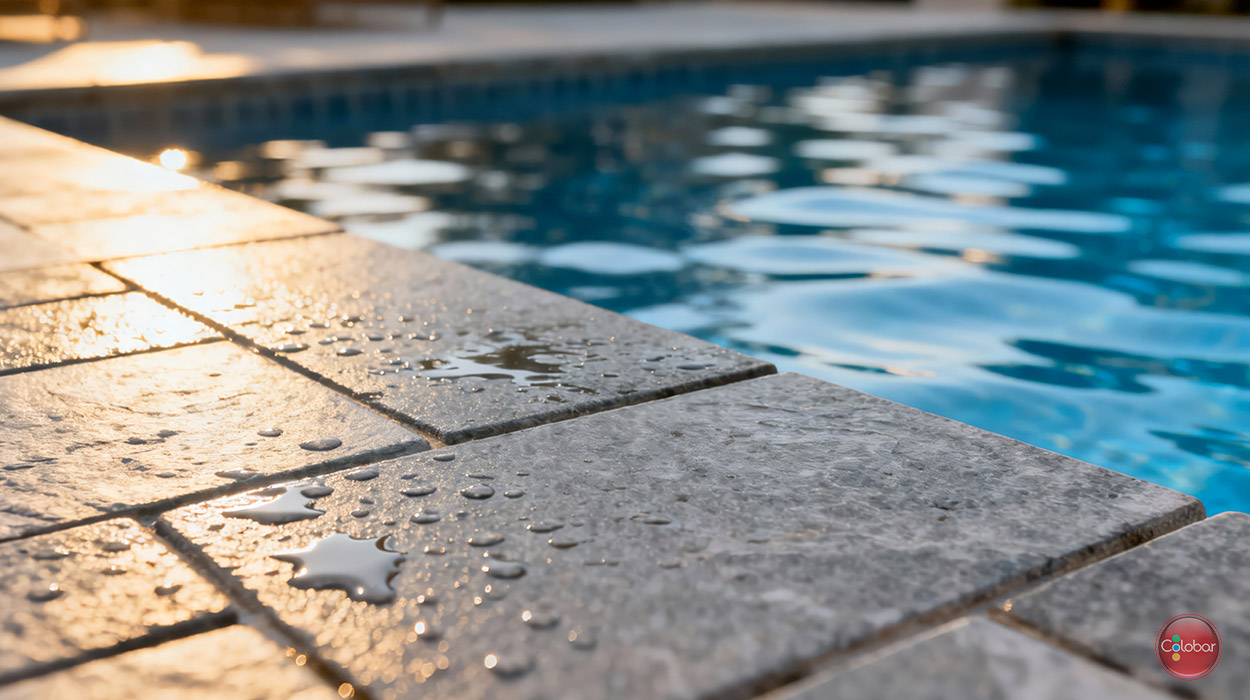
The lifespan of a sealer can vary from one project to another. Traffic intensity, exposure to the elements, and the conditions under which the product was applied all affect its longevity. It is therefore difficult to give a precise lifespan.
Fortunately, there is a very simple little test to know whether it is time to renew the protection.
After a few years, simply pour a little water on your pavers or concrete surface:
- If the water beads up and stays on the surface, the sealer is still providing some protection.
- Conversely, if it is quickly absorbed by the material, it is generally a sign that the sealer has lost effectiveness.
You can then clean the surface properly and apply a new coat of sealer to renew its protection.
05
The best conditions for applying your sealer to interlocking pavers
Here are all the conditions that must be met to avoid adhesion problems:
- The surface must be dry before applying the sealer. Do not apply paver sealer if it has rained in the last 24 hours or if there is a risk of imminent rain.
- Moisture in the pavers must be below 4% at the time of application.
- If ambient humidity is above 85%, it is best not to proceed with the application.
- The temperature must be between 10 and 30℃. To prevent the sealer from drying too quickly, it is best not to apply it in direct sunlight.
- In the case of recently poured concrete, you must wait at least 28 days before applying the sealer. Otherwise, the concrete pH is too high and the sealer will not adhere to the surface.
Start your project now!
You will find all the products you need directly on our website.
- Start by measuring the dimensions of your interlocking paver or concrete surface to calculate the quantities you need.
- One gallon of paver sealer covers 150 sq ft
- Place your order online and choose between in-store pickup and home delivery.
Want to learn more about sealers and epoxy? Visit the section of our blog dedicated to this topic.
Products found in this article.

Solvent-based sealer for concrete & pavers Passeport Elite
Krud Kutter Cleaner
Concrete cleaner and masonry primer from Passeport Elite

The steps to follow to make your pool surrounds safe with an anti-slip paint. Which products to use for cleaning.
Pool surrounds—whether they are polished concrete slabs or wood boards—can become slippery when wet. For this reason, many of our customers want to apply an anti-slip coating to make their pool areas safer. The simplest and most economical solution? Paint your pool surrounds with an anti-slip paint!
Q&A
Q. Can I apply a sealer to pavers that have already been sealed?
Yes, but you must first check the condition of the old sealer. If it is still well-adhered and compatible with the new product, proper cleaning and preparation may be enough. However, if the old coat is flaking, whitening, or peeling, you will need to correct the problem before adding a new coat. Applying sealer over a finish that is already failing will simply make the situation worse.
Q. Why did my pavers turn whitish after applying the sealer?
A whitish appearance can occur when a coat of sealer is applied too thickly or when moisture remains trapped under the finish. That is why it is important to work with a thin, even coat on a perfectly dry surface.
Q. Does sealer make pavers slippery when they are wet?
This depends in particular on the product used, the type of surface, and the finish obtained. A naturally very textured surface generally retains more traction than a smooth slab. If your pavers are in an area that is particularly exposed to water, such as around a pool or in a driveway, it is best to take this into account before choosing your sealer.
Q. Can I apply sealer only to the areas that are stained?
This is generally not the best approach. A localized application can create differences in sheen or appearance between treated areas and the rest of the surface. For a uniform result, it is best to clean the stain first and then protect the entire section concerned.
Q. Can sealer completely prevent oil or grease stains?
A sealer reduces the porosity of pavers and slows the penetration of liquids, but it does not necessarily make the surface completely invulnerable. The longer a contaminant remains on the pavers, the more likely it is to eventually penetrate. The best habit is therefore to act quickly when a spill occurs.
Q. What should I do if I notice uneven areas after applying the sealer?
Do not automatically add a new coat of sealer to areas that look different. First, let the product dry completely to determine whether the difference is temporary or permanent. If the problem persists, you must identify the cause—moisture, excess product, or inadequate preparation—before attempting a correction.


