
Natural oils have been back in style for over a decade now. Whether for their environmental properties or their performance, their role in exterior wood finishing is becoming increasingly important.
Deck oils, for example, can be used on a wide variety of wood species, whether exotic or thermally modified.
Want to know more about exterior wood oils? We’ll explain what they have to offer and which one to choose based on your project.
01
Natural Oils for Exterior Wood
How natural oils became a standard in wood finishing again over the last two decades
Firstly, natural oils benefited from the current industry context. With the implementation of new environmental standards governing both product composition and VOC emissions during application, several synthetic oil-based stains had to be removed from the market or reformulated.
Natural oils are primarily composed of naturally derived ingredients and generally have low toxicity before and during application. Their VOC emissions also comply with new limits, which allowed them to remain on the market without undergoing the same changes as some synthetic oil-based stains.
These changes have led many consumers to re-evaluate their purchasing habits. Those wary of water-based stains naturally turned to natural oils. And in many cases, they successfully met their expectations, both in terms of appearance and wood protection.
02
What's the difference between natural oils and a 'normal' stain?
-
A more viscous texture
Natural oils are primarily made from vegetable oils to which other naturally derived ingredients are added, such as waxes or certain essences.
Since they generally contain fewer solvents than traditional stains, they often have a thicker texture. They may therefore appear more viscous upon application and sometimes require a slightly different working method.
Of course, not all natural oils are identical. Their composition and texture can vary from one manufacturer to another, which means the application method can also change.
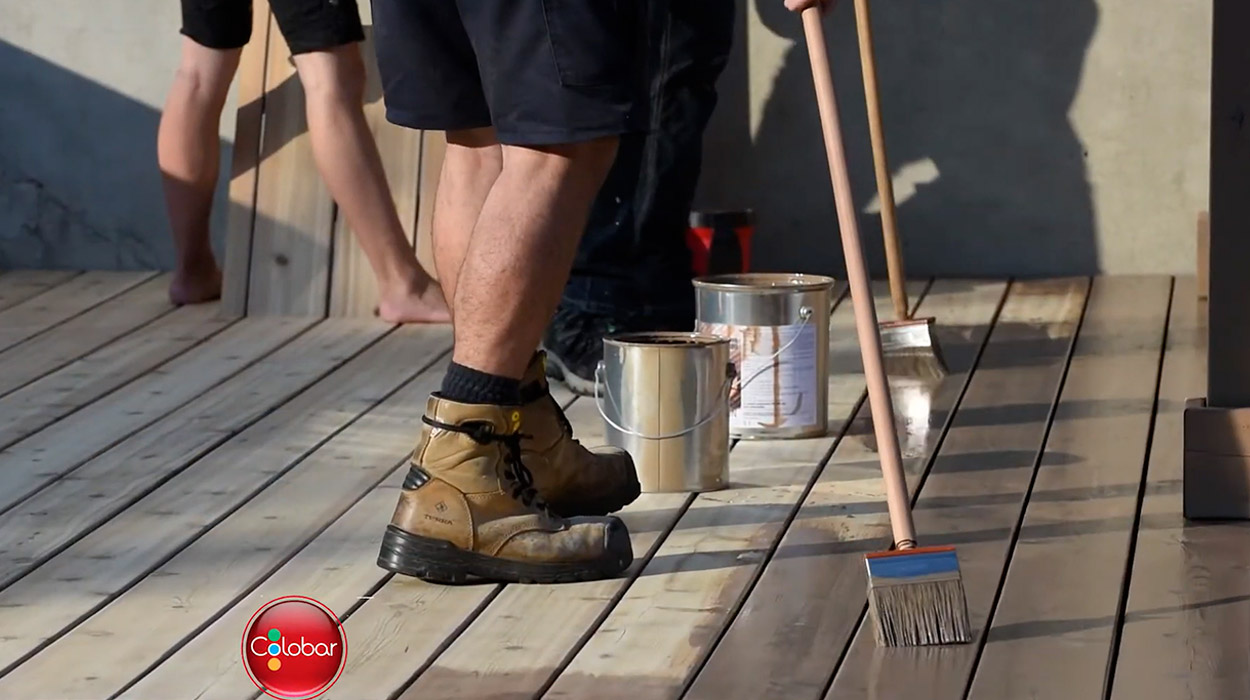
This thicker texture also slightly influences the application method for natural oil. As thinner stains generally penetrate or dry faster, you have less time to spread them on the wood.
With a natural oil, the working time is often a bit longer. This allows you to take your time to properly spread the product over the surface before it starts to dry.
This is an interesting advantage for application, as it is easier to achieve an even finish and avoid lap marks or visible brush strokes.
-
Excellent coverage
The thicker texture of natural oils also gives them good coverage. As they are more viscous than many stains, they can be spread over a larger area while still penetrating the wood sufficiently to saturate and protect it well.
Coverage is also linked to how the oil is absorbed by the wood. During the first coat, the wood absorbs a good amount of oil to fill and saturate its pores. Once this first coat is applied, the wood is already much more saturated.
The second coat therefore generally requires less product. In some situations, it is even possible to cover up to twice as much surface with the same amount of oil. In other words, the second coat may require up to 50% less product than the first.
This is another advantage of natural oils: the more saturated the wood, the less product is needed to achieve uniform coverage.
-
Unrivaled penetration
Even if natural oils do not immediately penetrate the wood pores like some thinner stains, they still possess excellent penetration properties. Indeed, natural oils penetrate deeply into the wood grain and can continue to penetrate for several hours after application.
This is one of the interesting features of natural oils: they take their time to penetrate the wood rather than simply remaining on the surface.
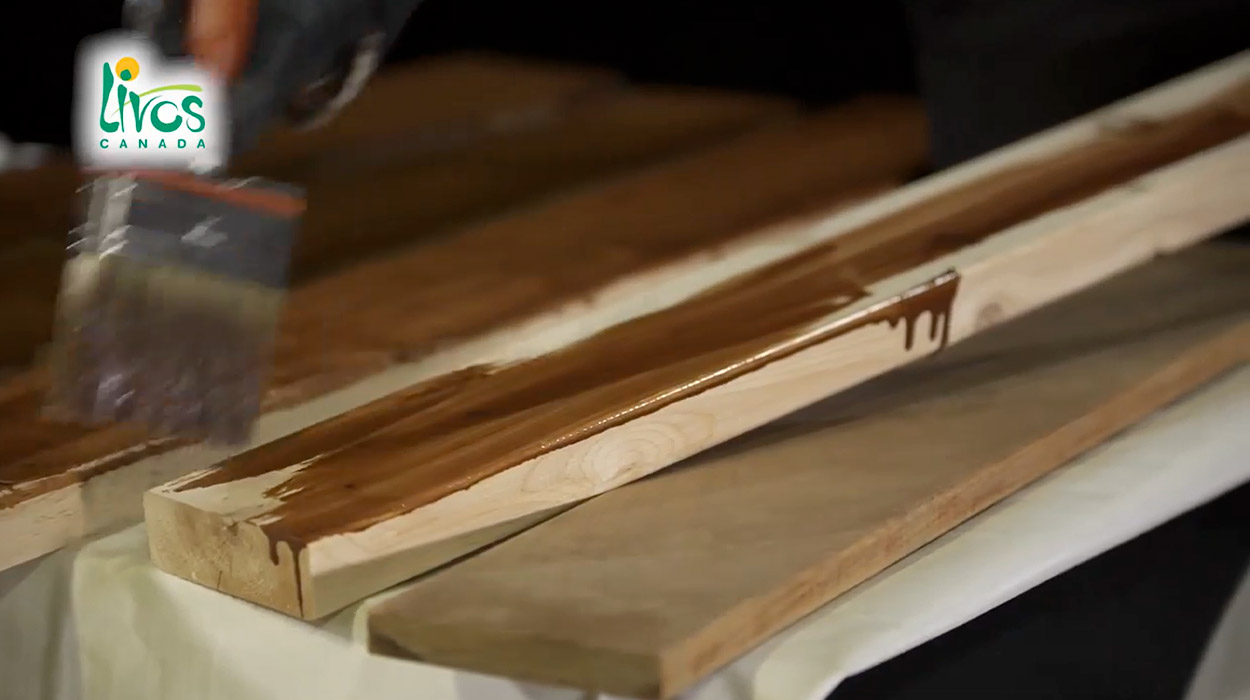
For this reason, natural oils are among the only wood finishing products that can be applied to very dense-grained or closed-grain woods. Such as exotic woods (Ipe, Teak) or thermally modified wood.
Finally, the components of natural oils are compatible with the sap and oils present in resinous woods. Notably, they are an excellent finishing choice for cedar surfaces.
-
A finish that lets the wood breathe
Some stains, whether oil-based or water-based, contain additives that form a protective film on the wood surface. This is particularly true for some semi-transparent stains with a glossier finish and, more markedly, for opaque stains.
This film protects the wood from weathering and limits water penetration. However, it also risks flaking over time.
Why? Because wood is an organic material that constantly moves. It absorbs moisture and also releases or allows it to pass through the surface. When moisture tries to escape the wood, it must pass through this film. As a result of these movements, the finish can detach and begin to flake.
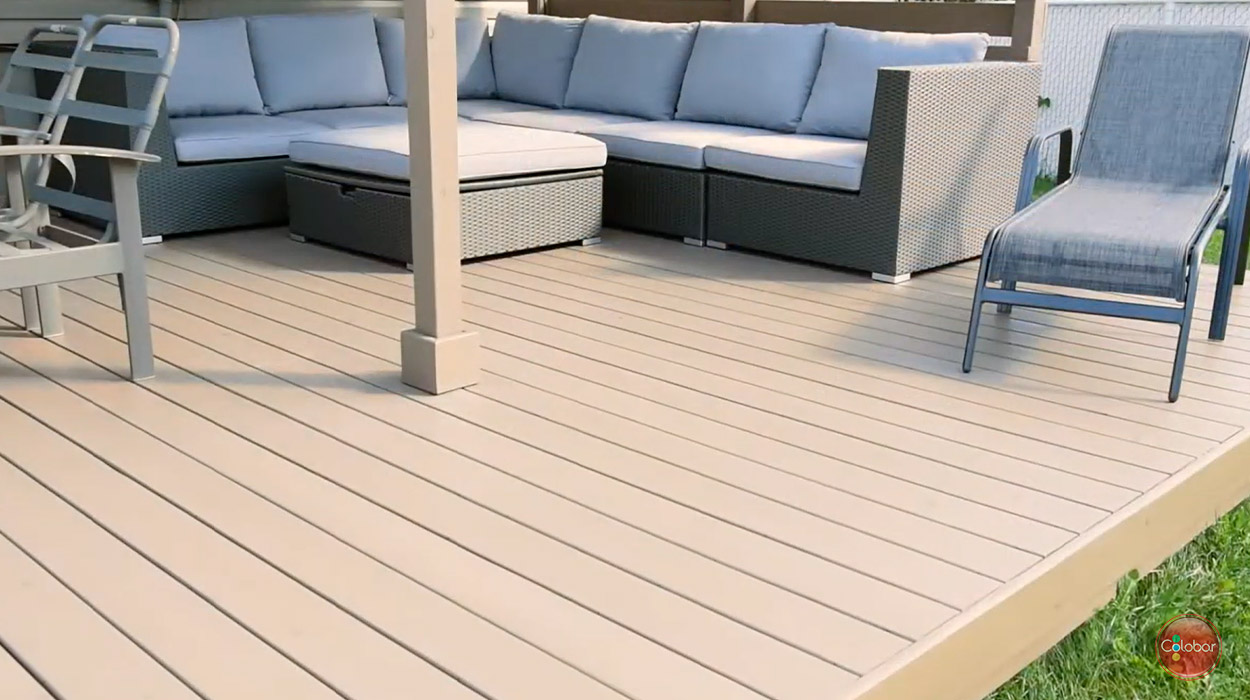
Cedar patio treated with Alis oil. Custom color
Conversely, natural oils penetrate deeply into the wood rather than forming a film on its surface. This is known as a non-film-forming finish. This type of finish has the advantage of allowing the wood to breathe. Oils are therefore less likely to flake over time.
Instead of peeling off the surface in patches, as a film-forming finish can do, oil tends to wear away gradually. When the protection starts to be damaged, you simply need to reapply a coat to revive the finish.
-
An easier-to-maintain finish
Indeed, by avoiding flaking, you also avoid having to sand the wood every time you want to refresh the finish. If you regularly maintain your oiled surfaces and do not let the finish wear away completely to the bare wood, it is generally sufficient to clean the surface and apply a new maintenance coat.
This saves you the most thankless task of patio finish maintenance: sanding.
03
Some Natural Oil Choices for Your Patio
-
Alis Deck Oil by Livos

“Best product for a cedar balcony. It doesn't peel; you just have to prepare it well and apply. It needs refreshing every year or every 2 years because it wears off faster at the wood knots. Expensive (nearly 3X the price of an ordinary product) but worth it because there's no peeling, making maintenance and refreshing easier. It lasts much longer on vertical surfaces.”
M. Dalbec, client confirmé
The natural oil Alis by Livos is a high-end finish designed for exterior wood. It can be applied to virtually all wood species, including cedar, treated wood, exotic woods, and thermally modified wood.
Alis protects wood against UV rays and graying, mold, moisture, and wear caused by foot traffic. This versatility allows it to be used on both vertical surfaces, such as siding and fences, and horizontal surfaces like patios, decks, and balconies.
Even though Alis is a non-film-forming finish, it gives the wood a slight satin appearance. This is what makes it appealing for projects where you are looking for a more refined or contemporary finish.
Environmentally, Alis contains no petroleum-derived oils. It is therefore pleasant to apply and does not emit an unpleasant odor. Moreover, according to our experience and the feedback from many of our customers, Alis even has a pleasant scent.
However, it is important to know that Alis is more expensive to purchase than many other finishing products. Its coverage and durability, however, make the investment more profitable in the medium and long term. For maintenance coats, you only need about 50% of the amount of oil used for the first application.
In other words, if you regularly maintain your finish and avoid letting it wear away completely to the bare wood, subsequent maintenance requires much less product. The cost of maintenance therefore becomes more attractive over time.
At Colobar, we have been recommending Alis for several years to customers looking for a finish that is both durable and aesthetic for their exterior wood. Our experience with the product and the feedback received from our customers have shown a very high level of satisfaction.
Finally, Alis is available in 20 basic colors that can be mixed to create custom shades. If you’re looking for inspiration to choose your color, consult our color selection.

Learn how to properly protect your patio with Livos Alis exterior oil in this video. These pro techniques will help you succeed in your project.
04
A Fast, Economical, and Durable Option with Ligna Extéria Oil

“Quality product difficult to find elsewhere. The online store makes it easy to place an order and pick it up quickly. Excellent service and advice when needed. Competitive prices.”
Patrice Senécal, client confirmé
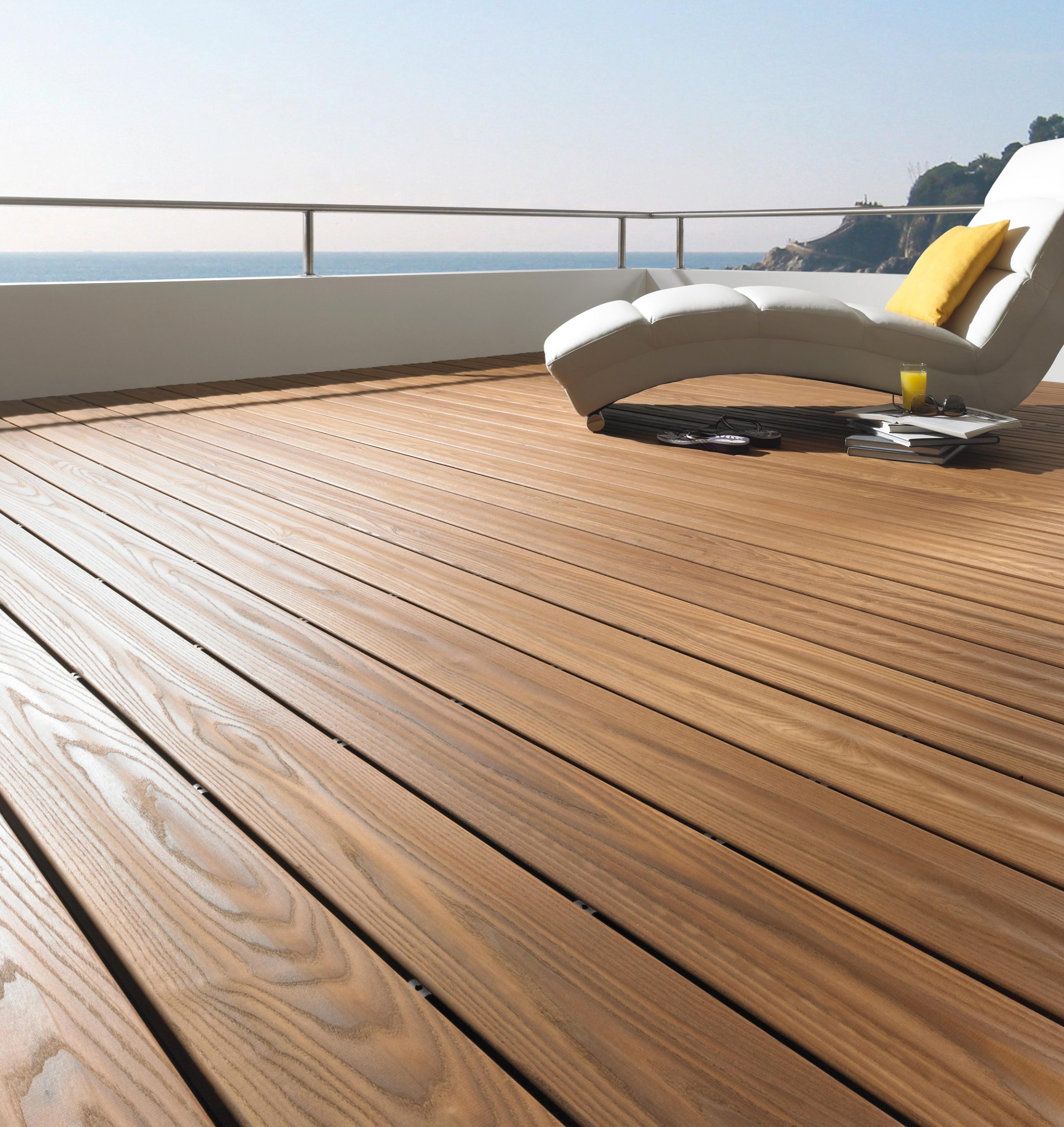
Ligna Extéria oil is also composed of naturally derived ingredients. It stands out notably for its 50% solids content, which is particularly high for a finishing oil.
Concretely, this gives it a thicker texture and allows it to be spread over a large area. Its coverage is therefore particularly impressive: depending on the type of wood and its condition, you can cover approximately 150 to 300 sq ft per liter.
This thicker texture, however, comes with a small compromise. During application, the oil is a bit more difficult to spread. Therefore, you need to take the time to spread it well on the wood.
Once applied, Extéria offers complete protection against mold, UV rays, and abrasion. It can therefore be used on both horizontal surfaces, like a patio, and vertical surfaces.
Another feature to know: Extéria is a wipe-on oil. After applying the product with a bristle brush, you must remove the excess with a cotton cloth. A tip to save time and avoid working on your knees? Attach your cloths to a mop or use a block with a lamb’s wool applicator, at the end of a broom handle.
We’ve created a table explaining the advantages and disadvantages of a wipe-on oil:
| Advantages of a wipe-on oil | Disadvantages of a wipe-on oil |
|---|---|
| Allows better control over the amount of product applied to the wood | Adds a step to the application process |
| Reduces the risk of lap marks | Extends the time required to complete the project |
| Promotes more uniform oil penetration into the wood | Requires additional handling after application |

Furthermore, another point that might interest you about Extéria is that it is an affordable product thanks to its excellent coverage. With just one gallon, you can apply both coats to a patio of approximately 400 sq ft!
05
A New Addition to the Colobar Range: Osmo Decking Oil

Price per sq ft: $0.66
- Eco-friendly: Made from natural oils, without harmful agents
- Easy maintenance: No sanding required for future applications
- Water beads on the surface: While allowing the surface to remain microporous
Osmo Decking Oil is a new product in the Colobar range.
Why did we add it, if we already have excellent oils like Extéria or Alis?
Firstly, it is a very high-quality oil in itself, in addition to having a more than reasonable price.
You can apply it with a brush, like a standard natural patio oil, or apply it by polishing using a microfiber applicator pad. Polishing application results in a slightly more lustrous finish, perfect if you want something with a chicer look.
Another unique feature of this oil is that you can cover it with Osmo Anti-Slip Decking Oil. This option is truly new for us. Since natural oils are products that penetrate the wood, it’s rare to find one that leaves an anti-slip finish on boards.
If you find that your patio is slippery after rain or if you want the area around your pool to be safer, this is an excellent option for you.
In short, Osmo oil stands out primarily for its versatility: a beautiful finish, application flexibility, and the possibility of adding anti-slip protection where needed.
Start your project now!
You’ll find all the products you need directly on our website.
- Start by measuring the dimensions of the surface you want to oil to calculate the quantities of product you need.
- Alis covers 100 sq ft (2 coats) per liter.
- Extéria covers between 150 and 300 sq ft (1 coat) per liter.
- Osmo Patio Oil covers 258 sq ft (1 coat) per liter.
- Choose the oil and color that best suits your needs.
- Place your order online and choose between in-store pickup and home delivery.
Want to know more about natural oils and wood treatment? Consult the section of our blog dedicated to this topic!
Products found in this article.
Alis Deck Oil

Extéria Oil for Exterior Wood

Osmo Patio Oil
Q&A
Q. Can I change the type of natural oil during future maintenance?
Yes, but you should not simply apply a new oil over the old one. Different oils do not necessarily have the same composition or the same way of penetrating the wood. Before changing products, you must ensure that the old finish is properly prepared (this may require sanding) or that the two products are compatible.
Q. What if my wood becomes darker after applying the oil?
It is normal for oil to slightly alter the appearance of the wood, especially when it has a color. However, the result may be darker than expected depending on the wood species, its level of preparation, and the amount of product absorbed. Always test on a small section or scrap piece before treating the entire surface.
Q. Can a natural oil be used on wood that has already grayed?
Yes, but the wood will generally need to be prepared before application. Graying, dirt, and old finish residues can prevent the oil from penetrating uniformly. Use a cleaner suitable for your oil; if necessary, sanding will help restore a more uniform surface before treating it.
Q. Why does my oil seem to disappear quickly after application?
On very porous wood or wood that has never been treated, the first coat can be absorbed quickly because the wood pores are not yet saturated. This phenomenon is particularly common on very dry wood. Therefore, it is not necessarily advisable to immediately add a large amount of product: instead, follow the manufacturer’s recommendations regarding the number of coats and the quantity to apply.
Q. Is a natural oil suitable for a patio that receives a lot of sun?
Yes, but not all oils offer exactly the same level of UV protection. If your patio is highly exposed to the sun, pay particular attention to the product’s pigmentation and its ability to protect the wood from ultraviolet radiation. A transparent or very lightly pigmented finish allows the wood to gray more quickly.
Q. How can I prevent my natural oil from giving a different result from one year to the next?
The final color can vary as the wood ages, absorbs oil unevenly, or has been prepared differently from one application to another. To maintain a uniform result, always start by properly cleaning the surface and ensure that areas where the old finish is still unevenly present are removed. Also, do a small test before treating the entire patio.


