

“Very satisfied with the product that was recommended to me for my garage. It applied really well on both the new drywall and the concrete block wall, as well as on the plaster ceiling.”
The garage is probably the most heavily used surface in the house. It’s where you tinker, store equipment, and take on all sorts of projects—some of them messy. That means the paint in your garage needs to be able to withstand rubbing, splashes, and everyday little mishaps.
So you can’t just choose any paint for this room. But what’s the best product for painting your garage walls to get a finish that’s both durable and easy to maintain?
Two paints are perfectly suited for painting your garage walls:
Let’s look at both products and their advantages.

01
Why Paint Your Garage Walls with Scuff-X
Benjamin Moore’s Scuff-X paint is specially designed for walls subject to heavy use. That’s exactly what’s needed for a garage, where walls are often put to the test. It’s easy to hang tools, move boxes, or rub objects against the surfaces. Unlike standard paint, Scuff-X offers better resistance to marks and wear caused by friction. So your walls stay in better condition, even when your garage is used for all kinds of projects.
Scuff-X is also resistant to water and moisture. Its formula contains agents that help protect the coating against mold. That’s a real advantage in a garage, especially when you wash your car with a hose and splashes reach the walls. This resistance also helps preserve the finish when you need to wash the surfaces regularly to remove dirt, grease, or dust. This way, you can maintain your walls more easily, without wearing out the paint prematurely.

Painting your garage walls made easy
Another advantage of Scuff-X is that it offers high resistance while remaining a single-component paint. In other words, you don’t need to add a catalyst or hardener before applying it, as is the case with some industrial products. So you can use the product directly, without having to deal with mixing and the extra hassle that comes with it.
Scuff-X is also a low-odor paint, which makes applying it much more pleasant. It’s even recommended by the Collaborative for High Performance Schools for educational facilities. This recognition is largely due to its low emission of volatile organic compounds (VOCs), which helps preserve indoor air quality.
Finally, Scuff-X allows for a quick return to use thanks to its fast drying time and its ability to cure quickly. So you won’t have to put your projects on hold for several days: you’ll be able to use your garage again in a much shorter time.
02
The Benefits of Command for Painting Your Garage

Command is a paint originally designed for maintenance work in places like schools, warehouses, and public or commercial buildings. In short, places where work needs to be done quickly and spaces need to be put back into service without too much delay.
What makes it particularly appealing? Its exceptional drying time. In just 15 minutes, it’s dry to the touch. After 1 hour, you can already apply a second coat. And after 24 hours, you can use your vertical surfaces normally, like your garage walls. It’s one of the only paints that lets you get the space back in service this quickly. A significant advantage if you want your garage to be functional as fast as possible!
Another major advantage of Command is that you can apply it on almost any type of material: wood, galvanized metal, ferrous metal, plaster, drywall, and concrete. Do you have metal ducts running through your garage or concrete walls to paint? No need to rack your brain buying several different paints: you can use Command on all these surfaces.
Finally, keep in mind that Command was originally developed for commercial use. It’s therefore built to withstand the demands of high-traffic, heavily used spaces. It’s a great choice if you’re looking for a durable paint for your garage, without having to sacrifice a quick return to service.
Can’t decide between Scuff-X and Command? Here’s a table to help you compare the products:
| Features | Benjamin Moore Scuff-X | Benjamin Moore Command |
|---|---|---|
| Paint Type | Acrylic copolymer-based latex paint | Water-based acrylic urethane enamel |
| Recommended Use | Walls subject to heavy use, especially in commercial spaces and high-traffic areas | Maintenance work and surfaces that need a quick return to service |
| Resistance to Friction and Scratches | Excellent resistance to scuff marks and scratches thanks to its scuff-resistant technology | Good resistance to abrasion, cracking, and chipping |
| Water and Moisture Resistance | Withstands repeated washing. Contains antimicrobial additives that inhibit mold growth on the paint film | Durable coating designed for different environments and surface types |
| Compatible Surfaces | Drywall, plaster, wood, masonry, and certain metal surfaces that have been previously primed or painted | Wood, ferrous metal, galvanized metal, aluminum, concrete, masonry, fiberglass, drywall, and plaster |
| Interior or Exterior | Interior only | Interior and exterior |
| Single-Component Paint | Yes. No catalyst or hardener to add | Yes. No catalyst or hardener to add |
| Dry-to-Touch Time | 1 hour (matte finish) | 15 minutes |
| Time Before a Second Coat | 2 to 3 hours (matte finish) | 2 hours (per technical sheet HP3920) |
| Return to Service | Allow up to 14 days before washing painted surfaces | 24 hours per technical sheet HP3920 |
| VOC Emissions | Less than 50 g/L | Less than 50 g/L |
| Approximate Coverage | 400 to 450 sq. ft. per gallon | 350 to 450 sq. ft. per gallon |
| Tool Cleanup | Soapy water | Warm soapy water |
03
Painting Your Garage Walls
Painting your garage walls mainly involves two steps: preparation and application.
Preparing your walls
Before starting any paint project, you should always check the condition of the surface to be painted. This is what determines the prep work needed to get a great, long-lasting result.
For example, if your garage walls are already painted with an oil-based paint, you’ll need to apply a primer before switching to a water-based paint. Without this step, the new finish may not adhere properly, and could crack or peel over time.
On the other hand, if your wall is in good condition and has already been painted with a water-based paint, you usually don’t need primer. A good cleaning and a few repairs, if needed, are often enough before applying the new coat of paint.
For a complete, more detailed walkthrough, check out our article on
preparing walls for a paint project.
Guide pour la préparation des murs pour un projet de peinture
Here’s an overview of how to prepare your walls:
- Protect the work area: start by removing furniture, tools, and accessories you don’t want to get dirty. If some items are too heavy or difficult to move, cover them with a plastic drop sheet. This will save you a lot of trouble once the paint is applied.
- Clean the walls: walls need to be clean before you start. If they’re dirty, dusty, or greasy, clean them with Passeport-Élite Biodegradable Degreaser. Then let the surface dry completely before moving to the next step.
- Sand if needed: if the old paint is chipping or flaking, or if the surface is too smooth or glossy, it’s best to lightly sand it with sandpaper. This creates better grip for the new coat of paint.
- Apply a primer if needed: in some cases, applying a primer is necessary to get a long-lasting result. This is especially true if the walls have never been painted before or if the old finish is oil-based.
Not sure what kind of primer you need? Check out our buying guide for interior primers.
Guide d’achat pour les apprêts (primer) intérieurs
04
Applying Scuff-X
Scuff-X and Command, despite their exceptional durability, are single-component paints. That means you don’t need to add a hardener, and you can apply them pretty much like regular paint.
Protect areas you don’t want to paint
- If you have baseboards or moldings you want to keep clean, cover them with painter’s tape.
Prepare the paint
- Open the paint can and stir it with a stir stick for 1 to 2 minutes.
- Make sure no resin buildup remains at the bottom of the can after stirring.
- Pour the paint into the paint tray.
- The tray’s well should be well filled, without overflowing onto the ridged ramp.
Cutting In
- Use a polyester brush to cut in the corners and edges of your garage walls.
- If you’re working as a team of two, one person can start rolling as soon as an edge has been cut in by the person with the brush.
Applying the Paint with a Roller
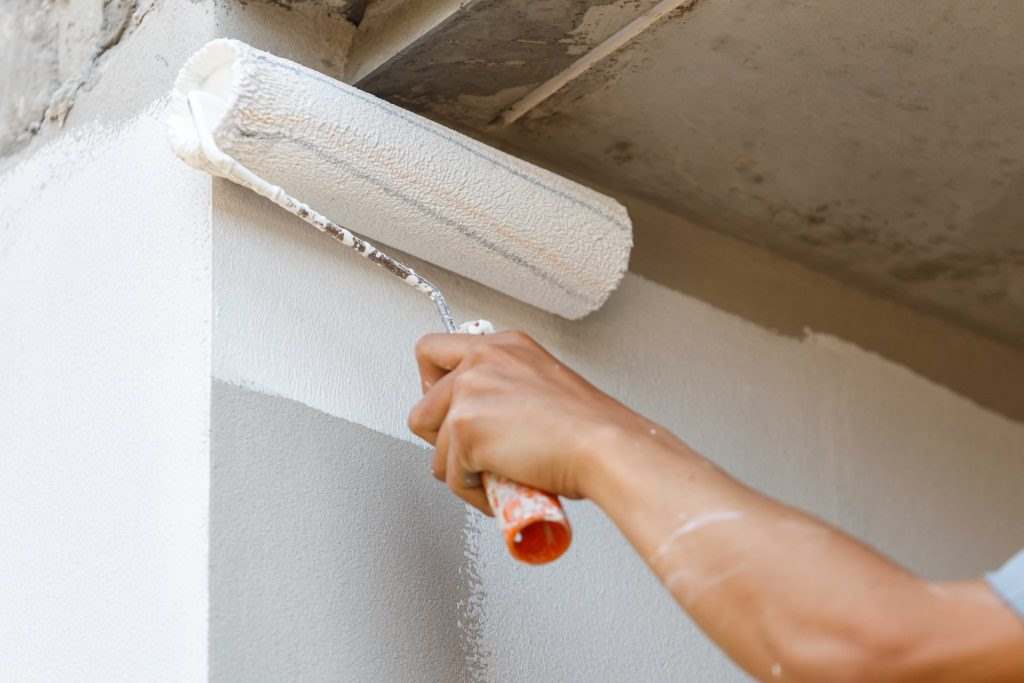
- Continue covering most of the surface with the roller.
- Your roller should be well loaded with paint, without dripping, to avoid drips and runs.
- Dip your roller into the tray’s well, then roll it several times over the ridged ramp to remove excess paint.
- To avoid lap marks, work in small sections of about 1 meter by 1 meter. If you spread out too large an area, the paint may start to dry before you finish going over it, which can create roller marks.
- Start applying from the top of the wall, then work your way down. You should also normally start on the side of the wall closest to the light source (for example, a window).
- Don’t move the roller too quickly—keep a steady, moderate pace.
- Don’t press too hard, to avoid runs.
- Continue this way until the entire wall is covered.
- Then move on to the next wall, repeating the same steps.
Applying the Second Coat

Start your project now!
You’ll find all the products you need right on our website.
- Start by measuring the dimensions of your garage walls to calculate the quantities you need.
- Choose the color you like.
- Place your order online and choose between in-store pickup and home delivery.
Want more tips for your painting projects? Check out our blog section dedicated to this topic.
Products found in this article.

Scuff-X Paint

Command Water-Based Enamel

5-Piece Set
Q&A
Q. Can I paint my garage walls if they're made of concrete or concrete block?
Yes, you can paint concrete or concrete block garage walls, but the surface often needs a bit more prep work than drywall. Concrete can be porous, dusty, or show signs of efflorescence. In that case, clean it with a cleaner that neutralizes efflorescence, then, if needed, lightly sand it.
Q. Do I need to remove old chipping paint before painting?
Yes, you need to remove any paint that’s chipping or flaking before applying a new coat. If you paint over peeling paint, the new finish is likely to follow suit and chip as well. Once the area has been stripped, lightly sand it to create a more even surface before painting.
Q. Can I paint my garage walls if they're damp or moldy?
No, you should never paint over a damp or moldy surface. If you notice moisture or signs of mold, you first need to identify the cause (water infiltration, condensation, etc.), fix the problem, then let it dry completely before painting. Painting over moisture is the surest way to see your paint deteriorate quickly.
Q. Can I use the same paint for my garage walls and ceiling?
Yes, you can use the same paint for the walls and ceiling, as long as the ceiling surface is also in good condition. A garage ceiling is often less exposed to friction than the walls, so a standard paint can sometimes do the job. Also consider using a matte or velvet finish. Otherwise, any imperfections in your ceiling will show through with a glossier finish. But if you want a uniform, long-lasting finish throughout, using the same paint simplifies the project.
Q. How long should I wait before putting my tools and furniture back in the garage?
After the second coat, let the paint dry for at least 24 hours before putting furniture or items back against the walls. Even if the surface feels dry to the touch after a few hours, full curing takes longer. If you put items back too soon, you risk leaving marks or damaging the finish.
Q. Can I paint my garage walls in winter, even if it's cold outside?
Yes, you can paint your garage walls in winter, as long as the temperature inside the garage is adequate. Most paints have a minimum application temperature (often around 10°C/50°F). If your garage is heated or the indoor temperature is high enough, you can paint even if it’s cold outside. However, avoid painting if the garage is very humid or if there’s condensation on the walls.


