

Has the wrought iron on your fence or your wall ornaments rusted? Are you wondering how to restore it and slow down the return of rust? Unlike galvanized metal, wrought iron is more prone to rust and can deteriorate quickly if it is not well protected.
If you want to extend the life of your wrought iron, it is important to do proper prep work and coat it with a good metal paint. We will show you how!
As with any restoration project, proper surface preparation is essential for a long-lasting result. Before you pick up a brush, you need to:
- clean the surface;
- remove the rust;
- treat any remaining rust residue to stabilize it.
01
Clean wrought iron before applying paint
Cleaning wrought iron is not complicated! The goal is simply to remove contaminants that could affect paint adhesion, such as dust, dirt, sand, and grease.
A few days before the work, you can clean the surface using a pressure washer. Then make sure to let the wrought iron dry completely before moving on.
Want to start the work the same day?
- Sweep and dust the surface thoroughly.
- To remove dirt and greasy contaminants, you can also wipe it down with a cloth soaked in a fast-drying solvent, such as methyl hydrate.
02
Remove rust from your wrought iron
If your wrought iron is already badly eaten away by rust, you will need to break out the sandblaster or grinder to remove the most damaged areas.
By removing rust, grinding helps smooth the surface and improve its appearance. It also creates a healthier, more adhesive base for primer and paint. That way, you ensure the new coat of paint will last much longer!

- The ideal tool for sanding your wrought iron is a flap wheel disc or a steel brush. The flaps make it easy to sand corners and hard-to-reach decorative details.
- When you are done, make sure to remove sanding residue by rinsing or dry dusting.
03
Neutralize rust on wrought iron with a metal conditioner
After removing as much rust as possible, applying a metal conditioner helps treat the oxidation residue that remains on the wrought iron.
The product chemically converts rust into a more stable metallic compound. This helps stabilize the surface and create a better base for applying primer and paint.
The conditioner also offers good long-term protection because it helps slow the return of rust. It can even neutralize the oxidation process before rust is visible to the naked eye.
In short, it is a step worth adding to your project: you better prepare your wrought iron for the finish while reducing the risk of rust coming back quickly.

“Very similar to a Dupont product I used for decades that I have run out of. The surface prep function is excellent(...) ”
André D. , client confirmé
How to apply the metal conditioner
The conditioner comes in liquid form. So you can apply it easily with a brush/roller or by spraying. Keep in mind that the temperature must be between 15 and 32°C during application.
- Apply the conditioner to the wrought iron and let it work for two minutes.
- Then rinse with water and let the surface dry.
- Wipe off excess water with a dry cloth.
Once that is done, you can move on to applying the paint.
04
Wrought iron paint: apply a rust-inhibiting primer
Do you want to maximize the life of your wrought iron and delay the return of rust? If so, it is in your best interest to apply a rust-inhibiting primer.
These primers are generally industrial-grade products. They can sometimes be a bit less pleasant to apply, but they offer superior protection and help extend the life and appearance of your wrought iron.

“Spray application, excellent coverage, one coat is enough. The primer provided a nice uniform finish when applying MetalForce paint. ”
Jean , client confirmé
Apply MetalForce rust-inhibiting primer
- Before application, thin MetalForce primer with MetalForce thinner. The recommended thinning ratio is 10%. For 1 litre of primer, add 100 ml of thinner.
- The primer is applied by spraying. You can focus only on the areas where rust was present, but for the best possible protection, it is ideal to cover the entire surface.
- Then let the primer dry for at least 30 minutes before applying the rustproof paint.
With proper surface preparation and a suitable finishing system, your wrought iron can keep its appearance and resist rust for many years.
TIP: Choose a primer colour that is different from your finish paint. The contrast will help you make sure you have fully covered the surface with the finish.
.
04
Apply rustproof paint to wrought iron
To protect your wrought iron long term, choosing the finish paint is just as important as surface preparation.
You have two options: a residential metal paint or an industrial-grade one.
We explain the pros and cons of each option.
Choosing between residential or industrial rustproof paint
All-purpose rustproof paints are generally easier and more pleasant to apply. They usually require no thinning or catalyst and can be applied with a brush, a roller, or a sprayer.
Industrial rustproof paints require a bit more preparation and are generally applied with a sprayer. In return, they offer superior protection and durability, which can be worthwhile for wrought iron that is highly exposed to the elements or when you want to maximize the life of the finish.
No matter which system you choose, plan on at least two finish coats for adequate protection. Always follow the drying times recommended by the manufacturer and pay close attention to weather conditions before, during, and after application.
| Advantages | HP2200 – Residential | MetalForce 45X-8XX – Industrial |
|---|---|---|
| Simple, versatile application | ✓ | |
| Ideal for residential projects | ✓ | ✓ |
| Can be applied with a brush, roller, or spray gun | ✓ | ✓ |
| Good corrosion protection | ✓ | ✓ |
| Good weather resistance | ✓ | ✓ Excellent |
| Good UV resistance | ✓ | ✓ |
| Excellent colour and gloss retention | ✓ | |
| Very glossy finish | ✓ | ✓ 90% and up |
| Fast drying between coats | ✓ 15 to 30 min | |
| 4-hour pot life after catalyzing | ✓ | |
| Suitable for commercial and industrial projects | ✓ | |
| Suitable for agricultural equipment and machinery | ✓ | |
| More specialized product for demanding projects | ✓ |
Apply residential rustproof paint

“Good paint that covers well”
Hélène Brousseau, cliente confirmée
With HP2200 metal paint, you get easy application as well as good durability. For application, no need to overthink it! You can apply it with a brush or a roller, like standard paint. If you want to apply it with a sprayer, follow these specifications:
Airless spraying: Pressure: 1500 – 2200 psi Nozzle: 0.015 – 0.019
- Stir the rustproof paint with a stick. Make sure to scrape the bottom to avoid pigment deposits. Throughout application, remember to stir from time to time.
- Use a poly-nylon brush or a premium-quality roller to avoid imperfections and bristles getting stuck in the paint.
- Apply an even coat over the entire surface.
- Let dry for at least 8 hours.
- Apply a second coat, following the same application steps as for the first.
04
how to apply an industrial paint to your wrought iron
Apply an industrial metal paint
If you are looking for the most durable solution to protect your metal, Pépin’s MetalForce rustproof coating is hard to beat. This industrial-grade paint offers excellent corrosion resistance and weather resistance, making it an excellent choice for fences, steel structures, farm machinery, or any other project where maximum durability is a priority.
However, applying it requires more preparation than a residential paint. Before you start, you need to thin it with the recommended solvent. For an even tougher finish and to prevent the paint from wrinkling during application, it is also recommended to add urethane catalyst 4000-23.
Thinning MetalForce rustproof coating
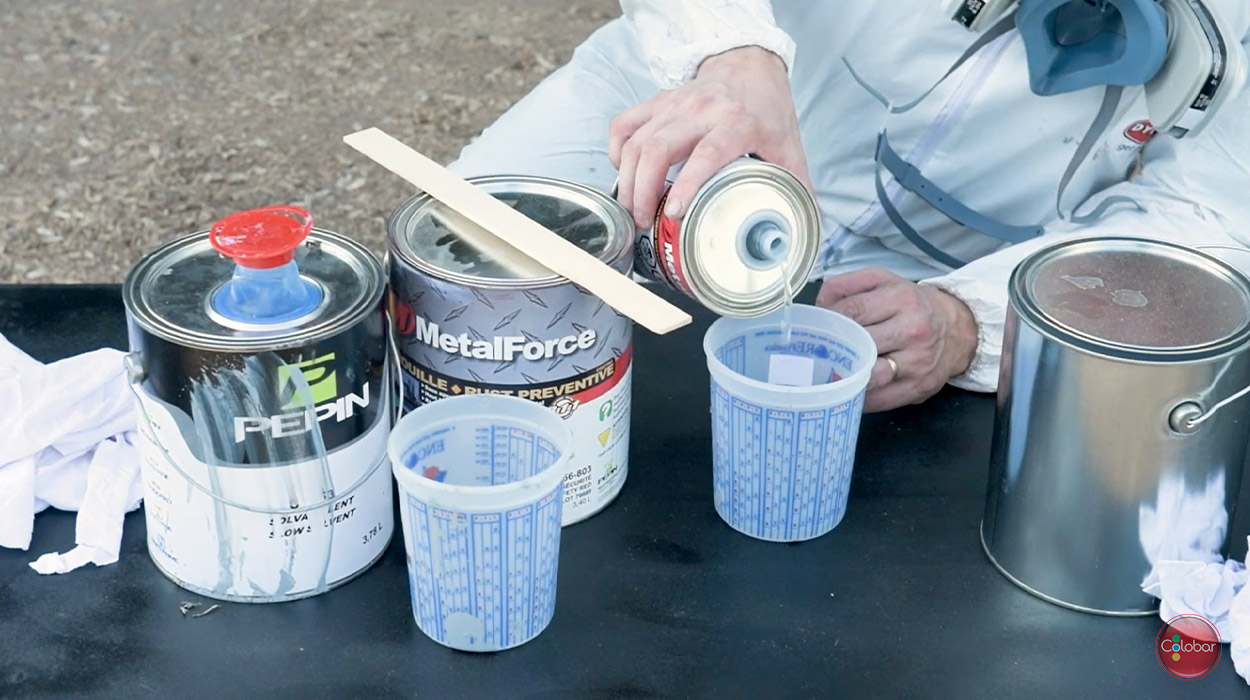
Proper thinning makes application easier and allows the coating to perform at its full potential.
- Add slow ST653 or regular ST661 solvent (for spray-gun application), up to a maximum of 10%. For example, pour 100 ml of solvent for 1 L of paint.
- Then add urethane catalyst 4000-23, also up to a maximum of 10%. For 1 L of paint, you can therefore add up to 100 ml of solvent and 100 ml of catalyst.
- Mix everything well with a wooden stick until you get a uniform mixture.
- Once the catalyst has been added, you have about 4 hours to use the paint. After that, the mixture will no longer deliver the expected results.
Apply MetalForce rustproof coating
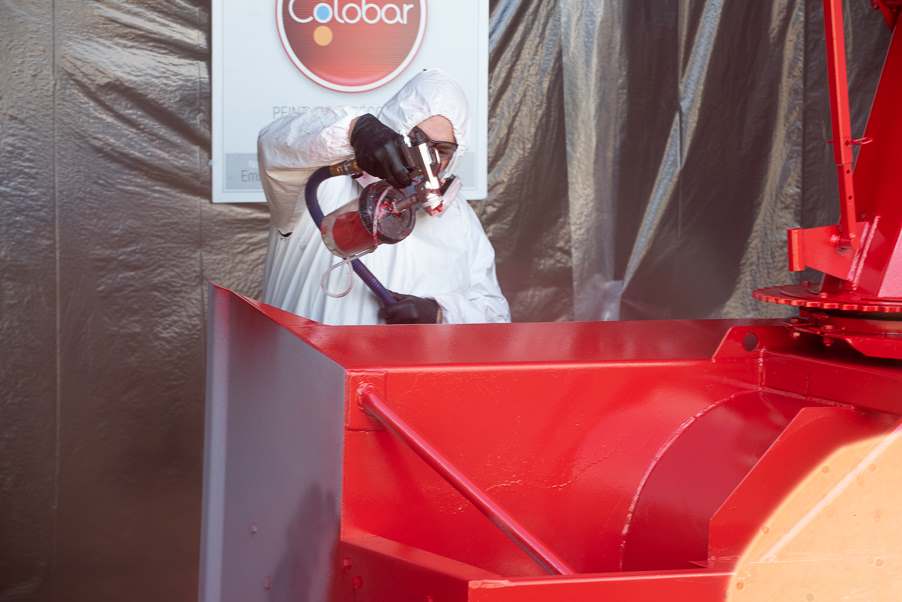
MetalForce rustproof coating is applied with a paint sprayer.
- Start by applying a first coat, following the recommended thickness of 2.5 to 3.5 mils dry film.
- For best results, apply the paint when the air and surface temperature is between 15 and 32°C.
- Then let dry for 15 to 45 minutes, and apply a second coat of the same thickness. The paint will be dry to the touch after about 45 minutes.
You will then need to wait 24 to 48 hours for it to reach full strength. If you added catalyst 4000-23, curing will be faster and the finish will be even more durable.
TIP: Choose a primer colour that is different from your finish paint. The contrast will help you make sure you have fully covered the surface with the finish.
.
Start your project now!
You will find all the products you need directly on our website.
- Start by measuring the dimensions of your wrought iron to calculate how much rustproof paint you need.
- Rust-inhibiting primer covers about 350 sq ft per gallon.
- MetalForce rustproof paint covers between 400 and 500 sq ft.
- Choose the colour you want for your wrought iron.
- Place your order online and choose between in-store pickup and home delivery.
Want to learn more about metal finishing and paint in general? Visit the section of our website dedicated to this topic!
Products found in this article.
Pépin quick-drying rust-inhibiting alkyd primer

Pépin Metalforce Industrial DTM Rustproof Paint

Metal PaintHP2200 (Custom color)
FAQ
Q. Do I need to remove all the rust before repainting my wrought iron?
Not necessarily. The main goal is to remove any rust that is loose or flaking off. Residue that does not lift from the metal can then be stabilized with a metal conditioner. However, painting directly over flaking rust is a mistake that will significantly reduce the life of the finish.
Q. Can I simply touch up the areas where the paint has come off?
Yes, if the remaining paint is perfectly adhered to the metal and the rust is localized. However, if the paint is peeling in several areas or corrosion is widespread, it is often better to restore the entire surface to achieve uniform protection.
Q. At what point is sanding with sandpaper no longer enough?
When rust is thick, the metal is scaling, or several layers of old paint are peeling, simple hand sanding rarely works. A grinder, a powered wire brush, or more intensive stripping will generally provide much better preparation.
Q. Do all rustproof paints offer the same lifespan?
No. Two paints can both be described as rustproof while offering very different performance. The choice mainly depends on the level of exposure to the elements, the desired maintenance frequency, and the durability you are looking for. For a fence or railing that is highly exposed, an industrial paint can be a more cost-effective long-term investment.
Q. Why does rust sometimes come back just a few months after the work?
In most cases, the paint is not the issue, but the surface preparation. Rust that was not properly removed, contaminants that were missed, or moisture trapped under the coating can allow corrosion to return quickly, even with quality paint.
Q. What is the best time of year to restore outdoor wrought iron?
Ideally, work in mild weather, on a perfectly dry surface, and when no rain is expected in the hours following application. Moderate temperatures generally allow the primer and paint to cure more evenly, which helps improve durability.


