

Description
Intumescent fire-retardant polyurethane varnish
PD-166
Drying
3–4 h to the touch
48 h to recoat
Coverage
300 sq ft per gallon
Number of coats
2 coats
*Flame spread rating 15 / smoke 50
Product description
* Note: For this fire-retardant product, the supplier does not provide a flame-spread time in minutes, but rather an effectiveness scale. Please note that the higher the rating, the less effective it is.
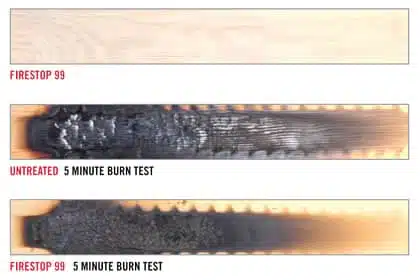
Flame Control No. 166 fire-retardant alkyd varnish is designed to provide a clear satin finish on interior wood surfaces where preserving the natural look of the wood is desired, while benefiting from a Class “A” flame-spread rating. When exposed to flame or intense heat, the coating expands to form a thick, insulating cellular foam. This foam layer delays heat penetration, reducing flame spread and smoke development. No. 166 varnish can be used on its own, with no additional topcoat. However, using No. 167 coating significantly improves the durability of No. 166.
Features
Clear, velvety satin finish for wood.
Can be topcoated with Flame Control No. 167 fire-retardant varnish for greater durability and higher gloss.
Can be used on its own with no additional topcoat.
Uses
No. 166 varnish is suitable for wall panels, ceiling panels, and other similar surfaces such as wood wainscoting.
It is not recommended for floors, doors, shelves, or areas likely to be exposed to moisture, high humidity, mold, or water, as the coating is slightly softer than conventional varnishes and its appearance may turn milky when exposed to damp conditions.
(For high-wear surfaces or areas likely to be exposed to damp conditions, we recommend the Flame Control Class “B” varnish system No. 129 and No. 130.)
A topcoat over 166 varnish is not necessary for many applications. However, any surfaces that will be handled, or where a low-sheen, semi-gloss, or high-gloss finish is desired, must be topcoated with Flame Control No. 167 fire-retardant topcoat after allowing 48 hours to dry thoroughly.
How to apply
Preparation
All dirt, grease, oil, wax, and other foreign matter must be removed.
NEW SURFACES:
If staining is desired, the use of wipe-on penetrating stains is recommended. Porous wood surfaces must then be thoroughly sealed with Flame Control No. 6 Clear Wood Sealer or a regular alkyd wood varnish in a satin finish before applying Flame Control No. 166 varnish. Allow the surface to dry completely before lightly sanding with 320-grit, remove dust, and proceed with the application of No. 166.
Stain is optional depending on the needs of the project, but sealing the wood is not before using Flame Control 166 varnish. It is recommended to prepare a representative sample of the system before starting the project.
PREVIOUSLY COATED SURFACES:
Test small areas. If the old coating is not affected, proceed with the application of No. 166. If the old coating is affected, it will be necessary to completely remove the coating, then treat it as a “new surface,” and apply Flame Control No. 6, 166, and 167.
NOTE: On prefinished V-groove panels, it may be necessary to seal the grooves before applying Flame Control No. 166 fire-retardant alkyd varnish, as they are very porous.
Application
It is important to mix the product thoroughly before use.
No. 166 can be applied by brush, airless sprayer, or heavy-duty conventional sprayer.
Apply a heavy coat at the recommended coverage rate of 300 ft² per gallon.
Note: two coats are required.
On wood panels and other large surfaces, it is recommended to use spray application, as it will provide a more uniform finish.
If thinning is necessary, use only Flame Control No. 166 Special Reducer. To comply with the surface-burning characteristics established for this varnish, any thinning must be compensated for by reduced coverage rates.
Airless spray specifications:
Fluid pressure . . . . 2000–2400 psi
Manifold filter . . . . . . . 60 mesh
Gun filter . . . . . . . . . . . . 60 mesh
Fluid hose . . . . . . ¼” diameter
Tip . . . . . . . . . . . . . . . . . .010–.013
Reduction . . . . . . . . . . Up to 7%
Cleaning and Maintenance
Important: Never use water or water-based cleaners to clean surfaces finished with this system because they will turn the surface finish milky. Use only oil-based wood-surface cleaners.
Restrictions and precautions
- Minimum application temperature is 10 °C (50 °F).
- Use caution during and after application, as the fire-retardant varnish contains volatile (combustible) solvents that can ignite.
- Keep away from heat, sparks, and open flames.
- Adequate ventilation must be provided during and after application until the coating is dry.
- Do not smoke and extinguish all flames from electrical appliances and any other ignition source.
- Avoid skin contact and inhalation of vapors or spray mist.
- Close the container after use.
Q&A
Q—My varnish is turning milky… what’s happening?
This is one of the most common issues.
No. 166 is sensitive to humidity and water. To avoid this:
- Avoid damp areas (bathroom ceilings, surfaces exposed to water)
- Use only solvent-based cleaners
Q—My finish isn’t uniform (streaks, sheen differences)… why?
Often, it’s related to the application method.
No. 166 is an intumescent varnish, so it is thicker than a standard varnish, which can cause unevenness during application. Here are a few tips for a successful application:
- Prioritize spraying for large surfaces
- Mix thoroughly before application and don’t forget to scrape the bottom of the gallon with a stick
- Apply a generous coat
Q—I’m not achieving Class A fire-retardant performance… why?
In 90% of cases, it’s a thickness issue or an incomplete system.
To ensure you obtain certification:
- Apply 2 coats of No. 166
- Follow the recommended coverage (300 ft²/gallon)
Q—The varnish gets damaged quickly or marks easily… is that normal?
No. 166 is slightly softer than a traditional varnish.
That’s the trade-off to achieve the fire-retardant effect (it expands when heated).
On high-wear surfaces (such as floors, doors, etc.), add one or two coats of No. 167 fire-retardant varnish to increase durability.
Q—The product doesn’t adhere well to an old surface… what should you do?
If there is an adhesion problem, it’s often due to preparation.
Here are the factors that will reduce adhesion:
- Presence of wax or grease
- Surface too smooth (glossy finishes)
- Incompatible old coating
You can fix this by:
- Cleaning with a solvent (mineral spirits)
- Lightly sanding to remove the old finish
- Doing a test before applying to the entire surface.
If it reacts poorly, you need to start over from scratch.
Q—Drying is taking too long or the product stays tacky… why?
No. 166 dries by solvent evaporation.
If it doesn’t dry properly, watch out for the following conditions:
- Lack of ventilation
- Temperature too low (minimum 10 °C, ideally between 15 and 32 °C)
- Coats applied too thick
You can ensure proper application conditions with ventilation and heating equipment. Also make sure you follow the coverage per gallon (300 ft²).






There are no reviews yet.